
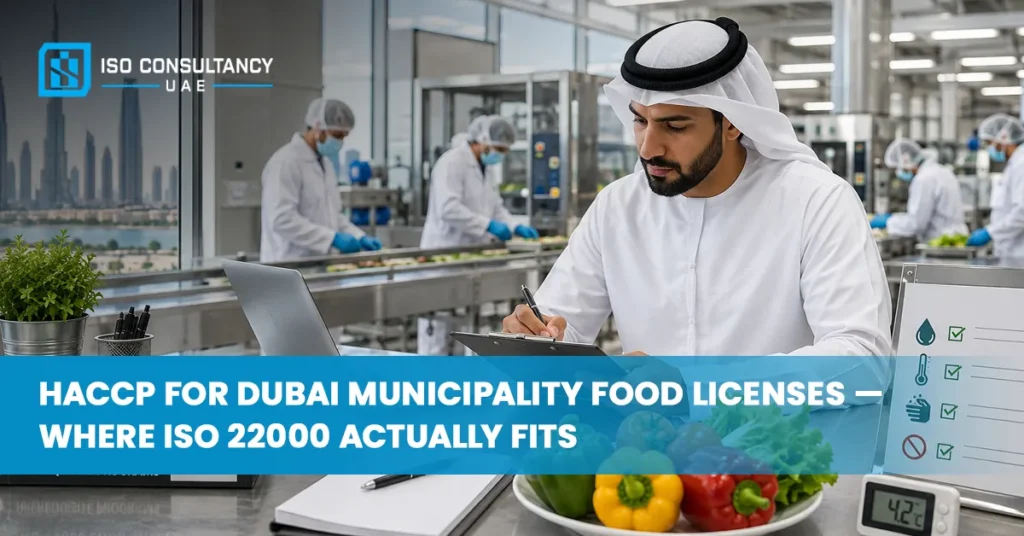
Many food business owners in Dubai get confused when they hear terms like HACCP and ISO 22000 in the same sentence. Some assume both are the same thing, while others believe having one automatically covers the other. This mix-up often leads to wrong decisions during the licensing process. Understanding HACCP Dubai Municipality requirements is the first step toward running a compliant and safe food business.
At the same time, it is important to know how ISO 22000 fits into the picture, since it is not always a mandatory replacement for HACCP. This article, prepared with input from ISO Consultants UAE, breaks down the real difference between HACCP and ISO 22000, and helps you understand which certification path suits your food business in Dubai.
Does Dubai Business Require HACCP for a Food License?
Food businesses in Dubai are expected to follow food safety rules that protect public health, and this is where the topic of HACCP Dubai Municipality compliance often comes up.
- Dubai Municipality sets out food safety requirements that apply to businesses handling, preparing, storing, or selling food, and these requirements are meant to reduce health risks for the public.
- HACCP-based food safety controls play a central role in identifying hazards early and putting practical control measures in place before problems occur.
- Requirements are not identical for every business, since a small café, a large catering company and a food factory may face different levels of control depending on their activity.
- Some establishments may need third-party HACCP certification as part of their operational or contractual requirements, depending on the nature and scale of their food handling activities.
- It is important to understand that ISO 22000 does not automatically remove every applicable Dubai Municipality food license requirement, so businesses should always confirm what applies to their specific category.
HACCP vs ISO 22000: What Is the Actual Difference?
Many people search for HACCP certification Dubai without realising that HACCP and ISO 22000 serve different purposes, even though they are closely related.
| Comparison Point | HACCP | ISO 22000 |
| Main purpose | Identifying and controlling food safety hazards | Managing food safety through a formal FSMS |
| Main focus | Hazard analysis and critical control points | HACCP principles plus wider management-system requirements |
| Documentation | HACCP plan and food safety records | FSMS documentation, HACCP controls and system records |
| Certification | HACCP certification may apply | ISO 22000 certification |
| Typical use | Food safety control requirements | Formal FSMS and customer or commercial requirements |
Where Does ISO 22000 Fit in Dubai Municipality Food Licensing?
Understanding iso 22000 Dubai Municipality expectations helps businesses avoid unnecessary confusion when applying for or renewing a food license.
- ISO 22000 is an internationally recognised Food Safety Management System, often called an FSMS, that gives businesses a structured way to manage food safety across the entire operation.
- HACCP principles are built into ISO 22000, meaning hazard analysis and critical control points remain part of the system, but with additional management-level requirements added on top.
- Dubai Municipality licensing and ISO certification are two separate things, and holding one does not automatically mean the other is not needed.
- ISO 22000 certification may be requested by certain buyers, hotel groups, retailers or export partners who want assurance of a formal food safety system.
- Every business should check its specific Dubai Municipality activity requirements before assuming that ISO 22000 alone is sufficient for licensing purposes.
Which Dubai Food Businesses May Need Third-Party Certification?
Not every food business needs the same certification, and the right choice usually depends on the type of activity being carried out.
- Food manufacturing businesses that produce packaged or processed food items for wider distribution across the UAE or for export markets.
- Catering companies that prepare large volumes of food for events, offices or institutions where food safety controls need to be clearly documented.
- Hotels and hospitality businesses that manage multiple food outlets, kitchens and room service operations under one food safety system.
- Restaurants and cafés that serve food directly to the public and need consistent, reliable food handling practices every single day.
- Cloud kitchens and other food-service businesses that operate delivery-only models but still handle raw ingredients and prepared food.
When Is HACCP Enough, and When Should You Choose ISO 22000?
Choosing between HACCP and ISO 22000 depends on your business size, activity type and who you are dealing with commercially.
When HACCP-Based Controls May Be Enough
Smaller food outlets that mainly need to control hazards at the kitchen or preparation level may find that a well-implemented HACCP-based system covers their day-to-day food safety needs adequately.
When Third-Party HACCP Certification May Be Relevant
There is a difference between simply implementing HACCP internally and obtaining independent certification, since certification involves an external body reviewing and confirming that your HACCP system meets recognised standards.
When Customers Ask for ISO 22000
Buyers, distributors and contract partners sometimes include certification requirements in their agreements, and this can directly influence whether ISO 22000 becomes a practical business necessity rather than an optional extra.
When Your Business Needs a Formal FSMS
Businesses with multiple sites, complex supply chains or several product lines often benefit from the wider management-system structure that ISO 22000 provides, since it covers more than just hazard control alone.
When ISO 22000 Makes More Commercial Sense
For companies aiming to grow, win larger contracts or work with export markets, ISO 22000 can support stronger supplier relationships, smoother B2B dealings and long-term business expansion plans.
What Documents and Records Should a Dubai Food Business Prepare?
Good documentation is the backbone of any food safety system, whether you follow HACCP alone or a full ISO 22000 structure.
- HACCP plan and hazard analysis that clearly identify potential risks at each stage of food handling and preparation.
- Process flow diagrams and CCP monitoring records that show how critical control points are tracked throughout daily operations.
- Temperature, cleaning and sanitation records that prove equipment, storage areas and surfaces are maintained correctly and consistently.
- Supplier, receiving and traceability records that allow the business to trace ingredients back to their original source when needed.
- Training, corrective-action and verification records that demonstrate staff understand procedures and that issues are properly addressed.
What Does an Auditor or Food Safety Inspector Actually Look At?
Inspections and audits are not only about paperwork, but they also focus on whether real practices match what has been documented.
- Whether food-handling practices match documented procedures during actual daily kitchen or production activities.
- Temperature monitoring and storage controls across fridges, freezers, cooking equipment and food display areas.
- Cleaning, sanitation and pest-control records that show consistent upkeep of hygiene standards throughout the premises.
- Staff training and food-handler practices, including how well employees understand and apply food safety procedures.
- Corrective actions, verification and traceability records that confirm problems are identified, fixed and properly followed up.
Common HACCP Mistakes That Can Create Problems During Dubai Inspections
Several avoidable mistakes can cause unnecessary issues during inspections, even when a business believes it is fully compliant.
- Using a generic HACCP plan that does not match the actual business, its menu, or its specific processes and equipment.
- Missing or incomplete monitoring records that leave gaps in the evidence needed to show ongoing food safety control.
- Unclear critical limits or CCP controls that make it difficult to prove hazards are being properly managed at each stage.
- Staff not following documented procedures, which creates a mismatch between what is written down and what actually happens.
- Treating HACCP documentation as paperwork instead of an active food safety system that should be reviewed and updated regularly.
Does a Food Business Need Both HACCP and ISO 22000?
This is one of the most common questions food business owners ask, and the answer depends heavily on individual business circumstances.
- HACCP and ISO 22000 have different scopes and purposes, so they are not simply two versions of the same requirement.
- ISO 22000 incorporates HACCP principles, meaning businesses certified to ISO 22000 are still applying HACCP concepts within a larger framework.
- Dubai Municipality requirements should be checked separately, since licensing rules are distinct from voluntary or commercially driven certifications.
- Customer or tender requirements may specifically request iso 22000 Dubai Municipality-compliant systems, which can make certification a practical necessity for certain contracts.
- The need for one or both ultimately depends on the business activity, scale of operations, and the specific requirements that apply to that business.
How to Choose the Right Certification Route in Dubai
Making the right choice starts with understanding your own business activity before comparing certification options.
- Identify the exact food activity and establishment category your business falls under, since this affects which requirements apply.
- Check the applicable Dubai Municipality food license requirements for your specific type of food operation before moving forward.
- Determine whether third-party certification is required by regulation, by your business model, or by commercial partners you work with.
- Compare HACCP certification Dubai options against ISO 22000 certification to see which better matches your operational needs and goals.
- Check customer, tender, export and supply-chain requirements, since these can influence which certification route makes the most practical sense.
How ISO 22000 Can Help a Dubai Food Business Beyond Licensing
Beyond meeting basic requirements, ISO 22000 can offer real operational value to food businesses that choose to pursue it.
- Creates a structured Food Safety Management System that organises food safety activities across the entire business rather than in isolated steps.
- Improves control over suppliers and food safety processes by setting clear expectations and monitoring throughout the supply chain.
- Supports internal audits and corrective actions, helping businesses catch and fix issues before they become bigger problems.
- Helps meet certain customer and B2B requirements, particularly when working with larger retailers, hotel chains or export partners.
- Provides a recognised framework for managing food safety risks that can strengthen trust with customers, partners and regulators alike.
Conclusion
Dubai Municipality requirements, HACCP and ISO 22000 each play a different role in keeping food businesses safe and compliant. HACCP focuses on identifying and controlling hazards, while ISO 22000 builds a wider management system around those same principles. They should not be treated as interchangeable, since choosing the right route depends on your business activity, applicable requirements, and the expectations of your customers or partners. Getting HACCP Dubai Municipality compliance right, and understanding where ISO 22000 genuinely fits, can save time and prevent costly mistakes.
ISO Consultants UAE works with food businesses across the Emirates to help them identify the right certification path and prepare the documentation needed for a smooth process. If you are unsure which route suits your business, reach out to ISO Consultants UAE for practical, straightforward guidance.
FAQs
Is HACCP mandatory for a Dubai food license?
Food businesses must meet the requirements applicable to their specific activity, and HACCP-based controls or certification requirements can vary depending on the establishment category.
Can ISO 22000 replace HACCP in Dubai?
ISO 22000 incorporates HACCP principles within its framework, but holding an ISO 22000 certificate does not automatically remove every applicable Dubai Municipality requirement.
Do restaurants in Dubai need ISO 22000?
ISO 22000 is not automatically required for every restaurant, so it is best to check the applicable activity rules, regulatory requirements and any specific customer expectations.
What is the difference between HACCP certification and ISO 22000 certification?
HACCP certification focuses mainly on HACCP-based food safety controls, while ISO 22000 certification covers a broader Food Safety Management System that incorporates HACCP principles.
Who can certify HACCP or ISO 22000 in Dubai?
Certification should be obtained through an appropriately accredited certification body operating under the applicable HACCP or ISO 22000 certification scheme.