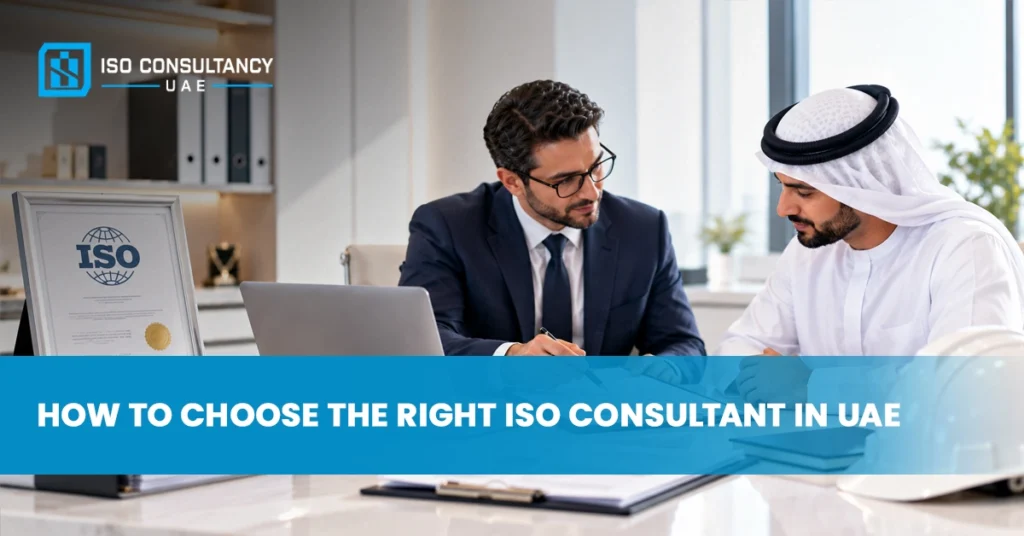
Choosing an ISO consultant is not simply about picking the cheapest quotation on your desk. The consultant you hire will shape how well your management system works, how prepared your team is for the certification audit, and how much internal effort the project takes. Businesses in the UAE usually start looking for ISO Consultancy UAE support because of customer demands, tender conditions, contracts, or their own internal goals.
An ISO consultant helps you build and prepare your management system. A certification body is a separate, independent organization that audits your system and decides if you qualify for the certificate. ISO does not issue certificates itself, and accreditation confirms a certification body is competent to do this work.
This guide covers everything you should check before hiring a consultant, from standards and experience to pricing, accreditation, and red flags.
Start With the ISO Standard Your Business Actually Needs
Before you compare consultants, get clear on exactly what certification your business needs and why. This decision shapes every other choice you make later.
Match the standard to your business objective
Different ISO standards solve different problems, so picking the right one matters more than picking the right consultant at this stage. ISO 9001 covers quality management, ISO 14001 covers environmental management, and ISO 45001 covers occupational health and safety. ISO 22000 applies to food safety, ISO 27001 to information security, and ISO 37001 to anti-bribery management. Some companies need an integrated management system that combines several standards into one framework.
Check who is asking for the certificate
The reason you need certification changes what your project should look like. A customer requirement, a tender condition, or a supplier qualification request each carries different expectations around timelines and scope. Regulatory or sector expectations may add extra documentation requirements a generic project would not include.
Define your certification scope before requesting quotations
Scope defines what the certificate will actually cover, so get this right before asking anyone for a price. Decide on the legal entity, the locations, the departments, and the products or services included. Include the emirate, the number of employees, and the number of sites, since these directly affect the consultant’s workload and your final quotation.
Know What an ISO Consultant Should Actually Do
A consultant’s job is more than writing documents for you to sign. Understanding their real responsibilities helps you judge proposals on substance instead of marketing language.
- Conduct an ISO gap analysis. The consultant should review your existing policies, processes, records, and legal requirements against the standard. This step also looks at operational controls and prior nonconformities.
- Build the system around your actual processes. Generic templates rarely hold up during an audit because they do not reflect how your business operates. A proper consultant maps your processes and builds forms and records around real activity.
- Prepare employees for implementation. Look for consultants who provide awareness training, role-specific training, and internal auditor training. Process owners need to understand their responsibilities, not just sign paperwork.
- Prepare the company for the certification audit. This includes running an internal audit, tracking corrective actions, and supporting management review before the certification body arrives. A UAE consultancy source points to internal audits, management review, corrective actions, scope, and evidence as the practical issues that determine audit readiness.
Check the Consultant’s ISO and UAE Industry Experience
Years in business tell you very little on their own. What matters is if the consultant has handled projects like yours before.
Ask for experience with your specific standard
Experience with one ISO standard does not automatically transfer to another. ISO 9001 experience is not the same as ISO 27001 experience, and ISO 45001 projects call for different operational understanding than a typical quality management project. Food businesses often need sector-specific knowledge a general consultant may not have.
Look for experience in your industry
Ask for examples of past projects in sectors close to yours, such as construction, manufacturing, healthcare, hospitality, food and beverage, IT, logistics, or trading. A consultant who has worked with similar operations understands your processes faster and asks sharper questions during the gap analysis.
Ask who will actually work on your project
Many companies promise senior expertise during the sales call and then hand the project to a junior team member. Ask directly who conducts the gap assessment, who prepares documentation, who delivers training, and who supports your internal audit. A clear answer signals a well-run consultancy, while a vague one is a warning sign.
Verify the Consultant’s Certification and Accreditation Claims
This is one of the most misunderstood parts of the process, so it deserves careful attention before you commit to any ISO Consultancy UAE proposal.
Do not confuse consultant credentials with certification body accreditation
A consultant provides advisory and implementation support, while a certification body performs the independent audit and issues the certificate. Accreditation applies to the certification body, not to a consultant’s claim of being an “ISO expert.” Keep these two roles separate throughout the buying process.
Check the certification body’s accreditation
Before you commit to a certification body, verify its name, its accrediting authority, the specific ISO standard covered, and the scope of its accreditation. EIAC states that it accredits management system certification bodies against ISO/IEC 17021-1 and maintains accreditation schemes covering standards including ISO 9001, ISO 14001, ISO 45001, ISO 22000, and ISO 27001.
Verify the certificate after it’s issued
Once your certificate is issued, confirm it through the certification body itself and through the relevant accreditation body. ISO recommends checking accreditation body information or using IAF CertSearch to confirm a certification is properly accredited. This extra step gives you real confidence in what you paid for.
Compare ISO Consultant Proposals Before You Compare Prices
Price alone tells you very little about what you are buying. Compare the full scope of each proposal first, then look at cost. A proper proposal should state the standard, the certification scope, the number of locations, the project duration, and every deliverable involved. It should also spell out training, gap analysis, internal audit support, and what happens after certification. If any of this is missing, ask for it in writing before moving forward.
- Gap analysis and documentation. Confirm if these are included as full activities or offered only as a brief overview.
- Training and internal audit. Check if employee training and internal audit support sit in the base package or get charged separately.
- Corrective action and certification audit support. Ask if the consultant stays involved through the certification audit or exits once documents are handed over.
Ask How the Consultant Will Build Your ISO System
The method a consultant uses tells you a lot about how well your system will work once it is live.
- Avoid consultants selling ready-made templates. Generic documentation often fails to reflect real operations, so employees struggle to follow it and auditors spot the gaps quickly.
- Ask how processes will be mapped. A proper approach includes interviews, site visits, and direct observation rather than a desk exercise built from a template library.
- Ask how implementation will be measured. Look for action plans, a responsibility matrix, clear deadlines, and tracked internal audit results rather than vague promises.
Check If the Consultant Understands UAE Requirements
A generic ISO consultant may miss details that only someone familiar with the local market would catch. This section confirms real local knowledge.
Ask about UAE regulatory and business requirements
Depending on your industry, federal rules, emirate-level rules, municipality requirements, and sector regulators may all apply to your project. Customer and tender requirements can add further conditions on top of this. A consultant who understands ISO Consultancy UAE work in your sector should walk you through these layers without hesitation.
Check experience with your emirate and locations
Practical requirements can differ across Dubai, Abu Dhabi, Sharjah, Ajman, Ras Al Khaimah, Fujairah, and Umm Al Quwain. This does not mean every ISO standard has a separate certification requirement per emirate, but local familiarity still speeds up the project and reduces avoidable mistakes.
Find Out How Long ISO Certification Should Take
Timelines vary a lot from one company to another, so treat any fixed number with caution.
- Company size and structure. More employees, locations, and complex processes generally mean a longer project.
- Existing management system. A company with some structure in place moves faster than one starting from scratch.
- Documentation and audit readiness. How quickly your team produces records and closes corrective actions directly affects the schedule.
Ask What Happens After the ISO Certificate Is Issued
Certification is not a one-time task that ends once the certificate arrives. Ongoing maintenance keeps the system valid.
- Surveillance audit support. Ask if the consultant helps prepare for the periodic audits that follow initial certification.
- Ongoing system maintenance. This includes internal audits, corrective actions, and recertification preparation over time.
- Post-certification fees. Confirm if support is included, billed annually, or charged per project.
Watch for These ISO Consultant Red Flags in the UAE
Some warning signs show up consistently across weak proposals. Watch for these before signing a contract.
- Guaranteed certification without proper assessment. No consultant can promise a result that depends on an independent auditor’s decision.
- Extremely low prices with unclear deliverables. The real issue is not the low price but the missing scope behind it.
- Generic documentation without process assessment. This usually results in a system that looks fine on paper but fails the actual audit.
- Consultant and certification body presented as one decision-maker. These two roles must remain independent by design.
- No named consultant or delivery team. If no one can tell you who will do the work, treat that as a serious gap.
- Pressure to purchase immediately. A transparent proposal does not need urgency tactics.
Use These Questions Before Hiring an ISO Consultant
Save this list and bring it to every consultation call.
- Which ISO standards have you implemented for businesses like ours?
- How many companies in our industry have you supported?
- Who will lead our project day-to-day?
- Will you conduct an on-site gap analysis?
- What exactly is included in the consultancy fee?
- Will documentation be based on our actual processes?
- Does the project include employee training and internal audit?
- Which certification bodies do you normally work with?
- Is that certification body independently accredited?
- What costs are excluded from your quotation?
- What support is available after certification?
What a Good ISO Consultancy Project Should Look Like
A well-run project follows a clear sequence rather than jumping straight to paperwork.
Step 1: Initial consultation and scope definition
The consultant meets with you to confirm the standard, the certification scope, and the business objective behind the project. This stage sets the foundation for everything that follows.
Step 2: Gap analysis and system development
The consultant reviews your current setup against the standard and starts building documentation around your real processes, including procedures, forms, and risk-based controls.
Step 3: Implementation, internal audit, and certification
Employees receive training, an internal audit is run, corrective actions are closed, and management review takes place before the certification audit. Once the certification body completes its audit, the certificate is issued and maintenance begins.
How Much Should You Expect to Pay for an ISO Consultant in UAE?
There is no single fixed price for every business, since fees depend on several factors working together.
- Company size and scope. More employees, sites, and a wider certification scope generally increase the project cost.
- Standard and industry complexity. Some standards and sectors require more technical work than others, which affects pricing.
- Training and post-certification support. Additional training and ongoing support after certification usually carry separate costs.
Separate consultancy fees from certification fees
Ask for clear, separate figures covering consultancy work, the certification body’s audit fee, training, travel, and surveillance audits. Mixing these into one number makes it hard to compare proposals or spot hidden charges later. A transparent ISO Consultancy UAE provider should have no trouble breaking this down in writing.
When You May Not Need a Full ISO Consultant
Not every business needs a complete implementation package from start to finish. Companies with existing mature systems, experienced internal quality teams, or previous certification experience may only need targeted support. This could mean a gap assessment, an internal audit, a documentation review, or a certification-readiness check rather than a full project. Discussing this openly with a consultant shows they are focused on your actual needs, not the biggest package available.
Final Checklist for Choosing an ISO Consultant in UAE
- Correct ISO standard and certification scope identified
- Consultant has relevant industry and standard-specific experience
- Actual project team named and confirmed
- Gap analysis, documentation, and training included
- Certification body identified and its accreditation verified
- All fees clearly stated with no hidden charges
- Post-certification support and references reviewed
Get Started With the Right ISO Consultancy UAE Support
If you are still comparing options, a short conversation can clarify which standard fits your business and what a proper project should include. Our team can walk you through scope, pricing, and timelines based on your actual operations rather than a generic package.
Conclusion
Choosing the right consultant starts with your business objective and the standard that matches it. From there, define your certification scope, check real industry and standard-specific experience, and confirm who will deliver the work. Keep consultancy and certification separate in your mind, verify accreditation through proper channels, and compare full proposals rather than headline prices alone.
There is no single “best” ISO Consultancy UAE provider for every business. The right choice is the one whose scope, expertise, implementation method, and commercial terms genuinely match what your company needs to reach certification and maintain it going forward.
FAQs
Is an ISO consultant the same as an ISO certification body?
No. A consultant helps you prepare and implement your management system, while a certification body is an independent organisation that audits the system and issues the certificate. These two functions must stay separate to protect the integrity of the certification.
Should I choose an ISO consultant based on price?
Price matters, but it should never be the only factor. Compare the full scope of each proposal, including gap analysis, training, internal audit, and post-certification support, before deciding on cost alone.
How can I verify a certification body is accredited in the UAE?
Check the certification body’s accreditation status directly with EIAC or use IAF CertSearch to confirm the details. This confirms the certification body is authorised to issue certificates against the standard you need.
How long does ISO consultancy usually take in the UAE?
Timelines depend on company size, existing documentation, and how quickly internal teams complete assigned tasks. Most projects take a few months, though this varies based on scope and readiness.
Can a business implement ISO without hiring a consultant?
Yes, especially if the company already has an experienced internal quality team or prior certification experience. Many businesses still choose limited support such as a gap assessment or internal audit instead of a full engagement.