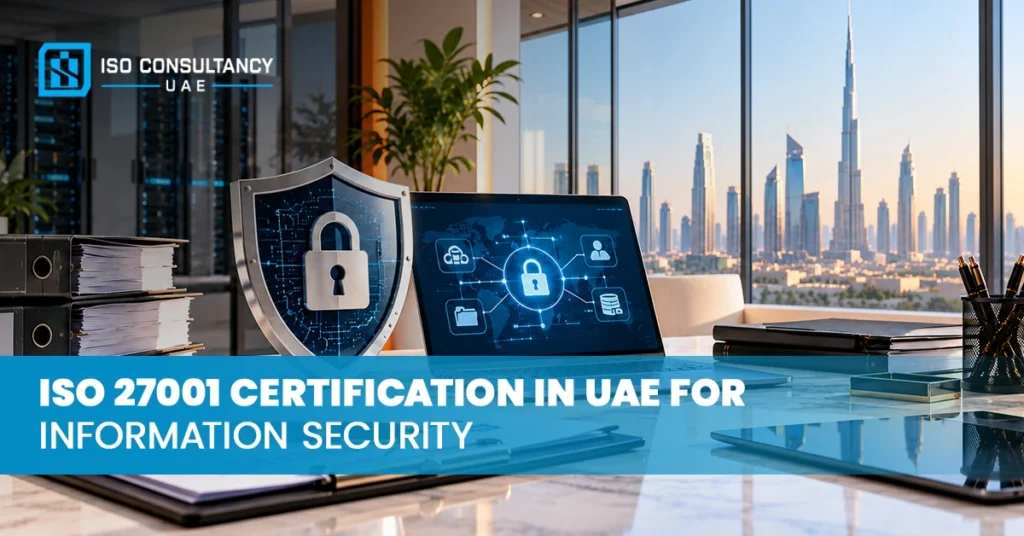
As businesses across the UAE become increasingly dependent on cloud platforms, digital systems, remote working, online transactions, and connected technologies, protecting sensitive information has become a fundamental business priority. ISO 27001 certification UAE provides organizations with a globally recognized framework for establishing, implementing, maintaining, and continually improving an Information Security Management System (ISMS). It enables businesses to identify security risks, implement appropriate controls, protect critical information, and demonstrate a structured commitment to information security.
ISO Consultants UAE helps organizations understand ISO requirements, assess their current security practices, develop practical ISMS frameworks, prepare employees, conduct internal audits, and coordinate certification activities. The objective is not simply to obtain a certificate but to establish information security practices that support business continuity, customer confidence, regulatory expectations, and long-term growth.
What Is ISO 27001 Certification?
ISO/IEC 27001:2022 is the internationally recognized standard for Information Security Management Systems. It establishes requirements for organizations that want to systematically manage information security risks and protect information assets. The standard can be applied to organizations of different sizes and across virtually every industry.
Unlike an approach that focuses only on cybersecurity technology, ISO 27001 considers people, processes, technology, physical environments, suppliers, and management responsibilities. Organizations identify their information assets, assess relevant risks, determine suitable treatments and controls, and continuously evaluate whether their security arrangements remain effective.
The current standard is ISO/IEC 27001:2022. ISO also published Amendment 1:2024, which introduces climate-action considerations into the management-system requirements.
Why ISO 27001 Matters for UAE Businesses
The UAE has developed a highly digital and internationally connected business environment. Companies in financial services, healthcare, technology, e-commerce, professional services, telecommunications, logistics, and other sectors routinely process confidential customer and corporate information.
Security failures can result in operational disruption, financial losses, damaged reputation, contractual problems, and regulatory concerns. A structured information security management system allows organizations to identify vulnerabilities before they develop into serious incidents.
For businesses targeting information security UAE requirements, ISO 27001 can provide a systematic framework for managing risks related to confidentiality, integrity, and availability. ISO explains that the standard helps organizations manage information-security risks through a holistic approach involving people, policies, and technology.
Certification can also strengthen confidence among customers, suppliers, investors, and enterprise partners that information security is being managed through an established and independently assessed framework.
Who Needs ISO 27001 Certification in the UAE?
ISO 27001 is suitable for organizations that create, store, process, transmit, or manage valuable information. It is particularly relevant to businesses whose customers, partners, or regulators require evidence of structured information security practices.
Organizations that may benefit include:
- Technology and software companies
- Fintech and financial services businesses
- Banks and other financial institutions
- Healthcare and medical organizations
- Cloud service providers
- Data centers
- E-commerce businesses
- Telecommunications companies
- Legal and professional service firms
- HR and payroll providers
- Educational institutions
- Government and semi-government organizations
The standard is not restricted to large enterprises. ISO confirms that ISO/IEC 27001 can be applied by organizations of different sizes and sectors, with the ISMS scaled according to the organization’s needs and circumstances.
Key Requirements of ISO 27001
Information Security Policy
An organization needs a clear information security policy that establishes management commitment, responsibilities, objectives, and the overall direction of its ISMS. The policy should be relevant to the organization’s activities and communicated to employees and other appropriate stakeholders.
Risk Assessment and Risk Treatment
Risk management is at the heart of ISO 27001. Organizations must identify relevant information-security risks, evaluate their potential impact and likelihood, and determine appropriate treatment measures.
Risk treatment may involve implementing controls, transferring a risk, avoiding a particular activity, or accepting a risk based on defined criteria.
Asset Management
Businesses need to understand what information assets they possess and how those assets should be protected. Asset inventories and information classification help organizations determine which data, systems, devices, and resources require stronger security measures.
Access Control
Access to systems and information should be managed according to business requirements and security risks. Organizations may establish user-access procedures, authentication requirements, privilege management, and periodic access reviews.
Incident Management
An effective ISMS should define how security incidents are identified, reported, investigated, responded to, and reviewed. A documented incident-management process helps employees respond consistently when a security event occurs.
Business Continuity and Recovery
Information security also involves maintaining access to critical information and systems. Backup procedures, recovery arrangements, continuity planning, and testing can reduce the impact of system failures, cyber incidents, and other disruptions.
Supplier and Third-Party Security
Modern organizations often depend on cloud providers, software vendors, contractors, and external service providers. ISO 27001 encourages organizations to identify and manage information-security risks associated with these third parties.
ISO 27001 Certification Process in the UAE
A structured implementation process helps organizations prepare for certification while ensuring that the ISMS becomes part of normal business operations.
Step 1: Conduct a Gap Analysis
The process normally begins by reviewing existing policies, procedures, security controls, documentation, responsibilities, and operational practices against ISO 27001 requirements. The assessment identifies gaps and establishes priorities for implementation.
Step 2: Define the ISMS Scope
The organization determines which business functions, locations, systems, services, processes, and information assets will be included within the ISMS. A clearly defined scope makes the certification process more focused and manageable.
Step 3: Perform an Information Security Risk Assessment
Relevant threats, vulnerabilities, and potential consequences are identified and evaluated. The organization then determines how each significant risk will be treated and documents the resulting decisions.
Step 4: Develop ISMS Documentation
Depending on the organization and its scope, documentation may include an information security policy, risk assessment methodology, risk register, risk treatment plan, Statement of Applicability, access-control procedures, incident-management procedures, supplier requirements, and business continuity arrangements.
Step 5: Implement Security Controls
Selected controls are implemented according to the organization’s identified risks. ISO 27001 follows a risk-based approach, meaning organizations should determine appropriate controls according to their specific circumstances rather than applying an identical security structure to every business.
Step 6: Employee Awareness and Training
Employees have an important role in information security. Training can address phishing, password practices, secure data handling, acceptable use, incident reporting, and individual responsibilities.
Step 7: Conduct an Internal Audit
The internal audit evaluates whether the ISMS has been implemented effectively and identifies areas requiring corrective action before the external certification audit.
Step 8: Management Review
Top management reviews ISMS performance, audit findings, security risks, objectives, incidents, corrective actions, and opportunities for improvement.
Step 9: Certification Audit
An independent certification body evaluates the organization’s ISMS through the certification audit process. Businesses can work with an experienced consultant to prepare documentation, employees, evidence, and processes before the certification audit.
For organizations seeking professional implementation support, ISO 27001 Consultants in UAE can assist with ISMS implementation, risk assessment, documentation, awareness training, internal audits, and certification preparation.
Documents Required for ISO 27001 Certification
Documentation requirements depend on the organization’s scope, activities, risks, and selected controls. Common documents and records include:
- ISMS scope
- Information security policy
- Information security objectives
- Risk assessment methodology
- Risk register
- Risk treatment plan
- Statement of Applicability
- Asset inventory
- Access management procedures
- Incident management procedures
- Business continuity procedures
- Supplier security requirements
- Internal audit records
- Management review records
- Corrective action records
- Employee training and awareness records
The documentation should accurately represent actual business practices. Creating policies that employees do not follow can create significant weaknesses during an audit.
ISO 27001 Certification Cost in the UAE
The cost of certification varies from one organization to another. Factors include company size, number of employees, number of locations, complexity of IT systems, ISMS scope, existing security maturity, consultant involvement, and certification-body audit fees.
A small business with a clearly defined scope may require fewer resources than a multinational organization operating multiple locations and complex information systems. Businesses should therefore obtain a scope-specific quotation rather than relying on a standard market price.
How Long Does ISO 27001 Certification Take?
The implementation timeline depends on the organization’s existing security maturity and the complexity of its operations. Organizations with established policies, risk-management practices, and security controls may complete implementation faster than businesses starting from the beginning.
The overall process generally involves gap assessment, scope definition, risk assessment, documentation, implementation, employee training, internal audit, management review, and certification audits. Rushing these stages may result in an ISMS that exists mainly for certification rather than providing sustainable security value.
ISO 27001 and UAE Data Protection Requirements
ISO 27001 should not be considered a replacement for UAE data protection legislation or industry-specific regulatory requirements. Instead, it can provide a structured management framework for identifying and controlling information-security risks.
Businesses should identify the legal, regulatory, contractual, and industry requirements that apply to their operations. These requirements can then be considered during risk assessments and incorporated into appropriate policies, procedures, controls, and monitoring activities.
This is particularly important for organizations handling personal information, confidential customer records, financial information, intellectual property, or sensitive business data.
Benefits of ISO 27001 Certification for UAE Companies
Stronger Information Security
A structured ISMS helps organizations identify weaknesses systematically and introduce controls according to documented risks.
Better Protection of Sensitive Information
Customer information, employee records, financial data, intellectual property, and confidential business information can be managed through clearly defined policies and security procedures.
Improved Customer Trust
Certification can provide customers and business partners with additional confidence that an organization has established a systematic approach to information security. ISO describes certification as one way organizations can demonstrate their commitment and ability to manage information securely.
Reduced Operational Risk
Regular risk assessment, monitoring, internal audits, and corrective actions help businesses identify and address weaknesses before they cause significant disruption.
Support for Business Opportunities
Enterprise customers, procurement teams, and business partners may request recognized information-security certifications during supplier evaluations. ISO 27001 can therefore strengthen a company’s position when competing for contracts where security assurance is important.
Continual Improvement
ISO 27001 is not intended to be a one-time compliance exercise. Organizations are expected to monitor performance, conduct audits, review risks, address weaknesses, and continually improve their ISMS.
How ISO Consultants UAE Can Support Your Business
Implementing an ISMS involves more than preparing policies. Organizations need to understand their information assets, identify relevant risks, establish responsibilities, implement controls, and ensure employees understand their roles.
ISO Consultants UAE can support businesses throughout this process, including gap assessment, ISMS scope definition, risk assessment, documentation development, employee awareness, internal audit preparation, corrective actions, and certification coordination.
Businesses looking for broader ISO certification services in the UAE can also use professional support to integrate information security with other management-system standards where appropriate.
The goal should be to develop a practical ISMS that supports everyday operations and continues to provide value after the initial certification audit.
ISO 27001 for SMEs and Startups in the UAE
ISO 27001 is not limited to multinational corporations. Small and medium-sized businesses can also implement an ISMS by defining an appropriate scope and applying controls that reflect their actual risks.
For startups and SMEs working with enterprise customers, developing software, providing cloud services, handling confidential information, or entering regulated markets, certification can strengthen credibility and demonstrate a mature approach to information security.
ISO’s practical guidance for SMEs emphasizes that ISO/IEC 27001 can be implemented by smaller organizations and scaled according to their resources and circumstances.
Integrating ISO 27001 With Other ISO Standards
Organizations may integrate ISO 27001 with other management-system standards such as ISO 9001 for quality management, ISO 14001 for environmental management, and ISO 45001 for occupational health and safety.
An integrated management system can reduce duplicated processes and create a consistent structure for documentation, audits, management reviews, corrective actions, and continual improvement.
ISO also provides guidance for integrating ISO 27001 with ISO 20000-1, which can be useful for organizations managing information security alongside IT service management.
Maintaining ISO 27001 Certification
Certification is not the end of an organization’s information-security programme. The ISMS must continue to be monitored, reviewed, audited, and improved.
Organizations should regularly reassess risks when there are significant changes to technology, suppliers, employees, business operations, systems, regulations, or security threats. Internal audits and management reviews also help confirm whether the ISMS remains suitable and effective.
This ongoing approach makes ISO 27001 certification UAE more than a certificate. It becomes a management framework that supports stronger governance and resilience as the business evolves.
Frequently Asked Questions
Is ISO 27001 mandatory in the UAE?
ISO 27001 is not universally mandatory for every business in the UAE. However, specific industries, regulators, customers, contracts, and procurement requirements may make certification commercially or operationally important.
What does ISO 27001 cover?
ISO 27001 covers the establishment and management of an Information Security Management System. It addresses information-security risks through policies, processes, people, technology, controls, monitoring, and continual improvement.
Is ISO 27001 the same as cybersecurity certification?
No. ISO 27001 is a management-system standard for information security. It can include cybersecurity controls, but it also addresses governance, risk management, people, processes, responsibilities, and continual improvement.
Can small businesses obtain ISO 27001 certification?
Yes. ISO 27001 is designed to be applicable to organizations of different sizes and sectors. The scope and implementation approach can be adjusted according to the organization’s activities, risks, and resources.
How often should an ISMS be reviewed?
An ISMS should be continually monitored and periodically reviewed. Internal audits, management reviews, security incidents, major business changes, and changes in risk can all require further evaluation.
Conclusion
As UAE businesses continue to expand their digital operations, information security has become an important part of responsible business management. ISO 27001 certification UAE provides organizations with a recognized, risk-based framework for protecting information, strengthening security governance, improving customer confidence, and supporting continual improvement.
ISO Consultants UAE can help organizations move from initial gap assessment through ISMS implementation, employee awareness, internal auditing, corrective actions, and certification preparation. With the right scope and practical implementation approach, ISO 27001 can become an integral part of business resilience rather than simply another compliance requirement.