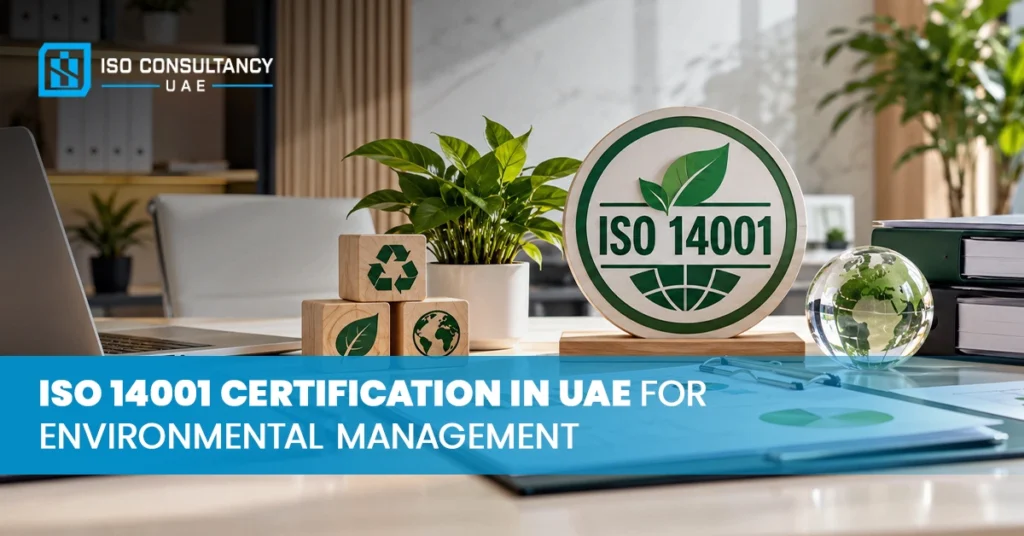
ISO 14001 certification UAE is increasingly relevant for organizations that want to control environmental risks, improve resource efficiency, and demonstrate a structured approach to environmental responsibility. For businesses operating across manufacturing, construction, logistics, hospitality, energy, healthcare, and other sectors, an Environmental Management System (EMS) can connect environmental objectives with everyday operations. The 2026 edition of ISO 14001 is now the current edition, replacing ISO 14001:2015, so businesses planning certification or transition should work from the latest requirements.
What Is ISO 14001?
ISO 14001 is an international standard for Environmental Management Systems. It provides a systematic framework for identifying environmental aspects, understanding compliance obligations, setting objectives, controlling operational impacts, monitoring performance, and continually improving environmental management.
Certification is not simply a document or environmental policy. It demonstrates that an organization has established and implemented a management system that is independently assessed against the applicable standard. The certification audit is performed by an independent certification body rather than by ISO itself.
Why Environmental Management Matters in the UAE
The UAE has continued to place greater emphasis on sustainable development, responsible resource use, pollution prevention, and environmental compliance. Businesses may also face environmental requirements from federal authorities, emirate-level regulators, municipalities, free zones, clients, and project owners depending on their activities and location.
For this reason, environmental management UAE is not limited to reducing waste or electricity consumption. It involves identifying the environmental effects associated with business activities and establishing controls that can be monitored and improved. A structured EMS can also help organizations respond more confidently to customer questionnaires, supplier assessments, tenders, and sustainability expectations.
Key Requirements of ISO 14001:2026
The current standard follows the management-system approach used across ISO standards while focusing specifically on environmental performance and environmental impacts. Important areas include:
Organizational Context and Environmental Conditions
The organization needs to understand its context, relevant internal and external issues, interested parties, and the scope of its EMS.
Leadership and Environmental Policy
Top management must demonstrate leadership and establish an environmental policy appropriate to the organization’s activities, impacts, and strategic direction.
Environmental Aspects and Impacts
The organization identifies activities, products, and services that can interact with the environment and determines which environmental aspects are significant.
Compliance Obligations
Applicable legal and other environmental obligations need to be identified, maintained, and considered when planning and operating the EMS.
Environmental Objectives and Planning
Organizations establish measurable objectives and determine actions, responsibilities, resources, and monitoring arrangements needed to achieve them.
Operational Control and Emergency Preparedness
Processes associated with significant environmental aspects must be controlled, while potential environmental emergencies should be identified and addressed through appropriate preparedness and response arrangements.
Performance Evaluation and Improvement
Monitoring, measurement, internal audits, management review, corrective action, and continual improvement help ensure that the EMS remains effective. The 2026 edition also places stronger emphasis on environmental performance, leadership, governance, resource efficiency, and current environmental priorities.
ISO 14001 Certification Process in the UAE
A practical ISO 14001 certification UAE project normally moves through several stages.
1. Initial Consultation and Scope Definition
The organization first defines its activities, locations, processes, products, services, and intended certification scope. A clear scope prevents unnecessary requirements from being added to the management system.
2. Gap Analysis
A gap assessment compares existing practices with the applicable ISO 14001 requirements. It helps identify weaknesses in documentation, legal compliance, environmental controls, monitoring, employee awareness, and management processes.
3. Environmental Aspects Assessment
Consultants or the internal team assess environmental interactions such as waste generation, emissions, energy use, water consumption, chemical handling, noise, transportation, and resource consumption. Significant aspects are prioritized for control.
4. EMS Documentation and Implementation
The organization develops the necessary policies, procedures, registers, objectives, operational controls, monitoring records, and other documented information. The system should be implemented in actual operations rather than prepared only for an audit.
5. Training and Awareness
Employees whose work can affect environmental performance should understand the relevant procedures, responsibilities, controls, emergency actions, and reporting requirements.
6. Internal Audit and Management Review
Before certification, an internal audit checks whether the EMS is implemented and effective. Management review then evaluates overall performance, objectives, compliance status, audit findings, resources, risks, and improvement opportunities.
7. Certification Audit
An independent certification body assesses the EMS against the standard. If nonconformities are identified, the organization must address them within the certification body’s process before certification can be completed. ISO confirms that certification is carried out by independent third-party certification bodies rather than ISO itself.
Benefits of ISO 14001 Certification for UAE Businesses
ISO 14001 certification UAE can provide both environmental and commercial value when the management system is properly implemented.
Better Environmental Performance
The EMS gives organizations a structured method for identifying significant impacts and controlling them through objectives, operational controls, monitoring, and corrective action.
Improved Resource Efficiency
Businesses can identify opportunities to reduce unnecessary consumption of energy, water, raw materials, and other resources. These improvements can support operational efficiency as well as environmental goals.
Stronger Compliance Management
Maintaining a clear register of applicable environmental obligations helps organizations understand what requirements apply to their activities and how compliance is monitored.
Reduced Environmental Risk
Systematic identification of environmental aspects and potential emergencies can help reduce the likelihood and consequences of environmental incidents.
Greater Customer and Tender Confidence
Certification can provide recognized evidence that environmental management is handled through a structured system. This can be valuable where customers, contractors, or procurement processes request environmental credentials.
A Stronger Foundation for Sustainability Initiatives
An established EMS can provide processes and records that support wider sustainability programmes, environmental reporting, and continuous improvement. ISO itself identifies improved environmental performance, regulatory compliance, risk management, cost savings, operational excellence, and stakeholder trust among the potential benefits of ISO 14001.
Industries That Can Benefit from ISO 14001 in the UAE
ISO 14001 is applicable across many sectors because environmental impacts are not limited to heavy industry. Manufacturing companies may use the system to control waste, emissions, chemicals, energy, and production-related impacts. Construction companies can address material use, waste, dust, noise, fuel consumption, and site-related environmental risks.
Logistics and transportation businesses can focus on fuel use, fleet impacts, maintenance waste, and operational efficiency. Hospitality organizations may address water consumption, food waste, energy use, cleaning chemicals, and waste segregation. Healthcare and pharmaceutical businesses may need structured controls for hazardous waste, chemicals, energy, water, and regulatory obligations.
Oil and gas, utilities, facilities management, food processing, retail, and other industries can also use an EMS to manage environmental aspects relevant to their operations. ISO confirms that the standard can be applied across sectors including manufacturing, energy, construction, transport, healthcare, hospitality, and public-sector organizations.
ISO 14001:2015 vs ISO 14001:2026
Organizations should pay close attention to the current edition when starting a new certification project. ISO 14001:2026 replaces the 2015 edition and retains the core management-system framework while updating and clarifying requirements for the present environmental and business context. ISO states that the new edition provides clearer guidance, easier navigation, stronger alignment with environmental priorities, and improved integration with other management-system standards.
Businesses already certified to ISO 14001:2015 should establish a transition plan with their certification body and review the updated requirements rather than assuming that existing documentation will automatically satisfy the new edition. ISO indicates that certified organizations will need to transition within the timeframe established through their certification cycle, typically around three years.
For organizations planning ISO 14001 certification UAE for the first time, using the 2026 edition from the beginning can provide a more appropriate foundation for long-term environmental management.
How to Prepare for ISO 14001 Certification
Preparation should begin with a realistic review of current environmental practices. Start by defining the scope and identifying relevant activities and locations. Next, determine environmental aspects, applicable obligations, significant risks, and existing controls.
The organization should then establish an environmental policy and measurable objectives, assign responsibilities, develop necessary operational controls, and train employees. Monitoring and measurement should generate useful evidence rather than paperwork created only for certification.
An internal audit is particularly valuable before the certification audit because it provides an opportunity to identify weaknesses and complete corrective actions. Management should also review EMS performance and ensure adequate resources are available for maintaining the system.
Businesses preparing for ISO 14001 certification UAE should also consider how environmental controls interact with existing quality, occupational health and safety, energy, or sustainability programmes. ISO 14001:2026 is designed to integrate smoothly with other ISO management-system standards.
How ISO Consultants UAE Can Support Your Certification
ISO Consultants UAE provides support across the ISO certification lifecycle, including gap analysis, EMS documentation, implementation guidance, employee training, internal audit preparation, and certification audit support. Its ISO 14001 service covers Environmental Management System implementation, compliance gap analysis, environmental legal register development, integrated management systems, training, and certification support. ISO 14001 Certification in UAE service
For businesses pursuing more than one management-system standard, ISO Consultants UAE can also help coordinate an integrated approach. Combining environmental, quality, and occupational health and safety systems can reduce duplicated processes where the standards and organizational structure allow integration. ISO Certification UAE services
Cost and Timeline Considerations
The cost and duration depend on factors such as organization size, number of locations, industry, environmental complexity, existing EMS maturity, documentation needs, and certification audit arrangements. A small organization with established procedures may require less implementation work than a large, multi-site industrial business.
Organizations should distinguish between consultancy or implementation costs and certification-body audit fees. A reliable proposal should clearly explain the scope of work, responsibilities, expected timeline, certification arrangements, and any ongoing support. Avoid choosing a provider solely on the lowest quoted price because the quality and practicality of the implemented EMS can directly affect audit readiness and long-term maintenance.
Conclusion
ISO 14001 certification UAE is more than an environmental credential. When implemented effectively, it provides a disciplined framework for identifying environmental impacts, meeting applicable obligations, improving operational controls, measuring performance, and driving continual improvement.
For UAE businesses preparing for certification under the current 2026 edition, the most effective approach is to build an EMS around actual operations rather than treating certification as a documentation exercise. ISO Consultants UAE can help organizations assess their readiness, develop practical systems, prepare employees, and approach the independent certification audit with greater confidence.
Frequently Asked Questions
Is ISO 14001 mandatory in the UAE?
ISO 14001 certification is not universally mandatory for every UAE business. However, specific contracts, tenders, clients, regulators, free zones, or industry requirements may make environmental management controls or certification commercially important.
What is the latest version of ISO 14001?
ISO 14001:2026 is the current edition. It replaces ISO 14001:2015, so organizations should use the current edition when planning new certification and address transition requirements where applicable.
How long does ISO 14001 certification take?
The timeline varies according to company size, scope, existing controls, number of sites, environmental complexity, and audit readiness. A gap assessment can provide a more realistic project timeline.
Can small businesses obtain ISO 14001 certification?
Yes. ISO 14001 can be applied to organizations of different sizes and sectors. The EMS should be proportionate to the organization’s activities, environmental aspects, risks, and compliance obligations.
What documents are needed for ISO 14001?
Typical documented information can include the environmental policy, EMS scope, environmental aspects and impacts assessment, compliance obligations, objectives, operational controls, monitoring records, internal audit results, management review records, and corrective-action evidence.