
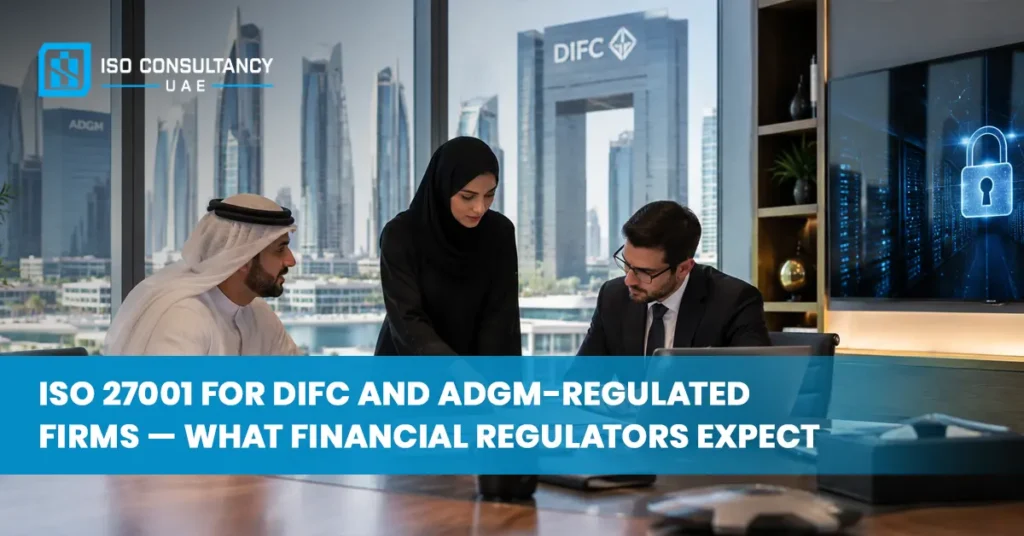
Financial firms operating inside the DIFC and ADGM free zones are under more regulatory pressure than ever to prove their data is secure. As cyber incidents rise across the UAE’s financial sector, ISO 27001 DIFC ADGM certification has shifted from a nice-to-have to a near-mandatory expectation for regulated entities. At ISO Consultants UAE, we’ve walked dozens of financial firms through this exact certification journey, and one thing is clear: regulators in both jurisdictions are no longer treating information security as a checkbox exercise.
This article breaks down what the DFSA and FSRA actually expect, how DIFC ISO 27001 obligations differ from ADGM information security rules, and what a realistic path toward ISO 27001 financial firms UAE compliance looks like in practice.
Why ISO 27001 DIFC ADGM Compliance Is No Longer Optional
Both the Dubai Financial Services Authority (DFSA) and the Abu Dhabi-based Financial Services Regulatory Authority (FSRA) have tightened expectations around how licensed firms manage information risk. While neither regulator explicitly mandates ISO 27001 by name, the framework has become the de facto benchmark regulators point to when assessing whether a firm’s security controls are adequate. Firms pursuing ISO 27001 DIFC ADGM alignment typically find that audits, client due diligence, and license renewals move faster once certification is in place.
DIFC ISO 27001 Requirements: What the DFSA Expects
Businesses that need support with implementing these requirements can work with ISO 27001 Consultants UAE to develop and maintain an ISMS aligned with their certification objectives.
- A documented Information Security Management System (ISMS)
- Risk assessments covering third-party and cloud service providers
- Incident reporting procedures tied to DFSA notification timelines
- Board-level accountability for cyber risk oversight
Firms that already hold this certification generally sail through DFSA technology risk reviews with far fewer follow-up questions.
ADGM Information Security Rules: The FSRA’s Approach
ADGM takes a slightly different regulatory posture. The FSRA’s guidance leans heavily on internationally recognised frameworks, and ADGM information security expectations are increasingly benchmarked directly against ISO 27001 controls, particularly for firms handling client money, payment data, or regulated financial products. Where DIFC focuses on documented governance, ADGM places more weight on evidenced operational controls: access logs, penetration test results, and vendor risk registers.
DIFC vs ADGM: A Side-by-Side Comparison
| Area | DIFC (DFSA) | ADGM (FSRA) |
| Primary regulatory reference | DFSA Rulebook (GEN, COB modules) | FSRA Guidance & Policy Manual |
| ISO 27001 status | Recognised best-practice benchmark | Strongly encouraged, often expected |
| Key focus area | Governance & board accountability | Operational evidence & controls |
| Third-party risk | Outsourcing module requirements | Vendor risk register mandatory |
| Incident reporting | DFSA notification timelines | FSRA breach notification rules |
What ISO 27001 Financial Firms UAE Certification Actually Involves
Regardless of which free zone a firm sits in, the certification path for ISO 27001 financial firms UAE follows a similar arc: gap assessment, risk treatment planning, control implementation, internal audit, and a two-stage external certification audit. Working with ISO 27001 Consultants UAE can help firms structure these stages around their regulatory environment and existing security controls.
ADGM Compliance ISO: Building a Sustainable Roadmap
Getting ADGM compliance ISO certification right isn’t just about passing the audit; it’s about building an ISMS that survives contact with real regulatory scrutiny. A workable roadmap typically includes:
- Scoping the ISMS around regulated activities, not the whole business
- Mapping FSRA/DFSA-specific reporting obligations into the risk register
- Running quarterly internal audits, not just annual ones
- Assigning a named information security owner accountable to the board
Firms that need support implementing this roadmap can work with ISO 27001 Consultants UAE to develop an ISMS that is structured around their security and regulatory requirements.
Which Firms Should Prioritise This
Not every entity in DIFC or ADGM faces the same level of scrutiny, but a wide range of regulated activities now sit squarely in the path of ISO 27001 DIFC ADGM expectations:
- Asset and fund managers handling investor data
- Insurance intermediaries processing client health or financial records
- Payment service providers and fintechs moving transaction data
- Wealth managers and private banks with cross-border client bases
If your firm falls into any of these categories, regulators are increasingly likely to ask about your ISMS during routine supervisory visits, not just during a formal audit cycle.
Timeline and Cost Expectations
Budgeting for certification is often where firms get caught off guard. A realistic certification project typically includes:
- Gap Assessment: Usually takes around two to four weeks to identify existing gaps and areas requiring improvement.
- Remediation and Control Implementation: This phase generally takes eight to twelve weeks, depending on the organisation’s existing maturity and the work required.
- Formal Certification Audit: The two-stage certification audit typically takes around four to six weeks, including scheduling.
- Cost Factors: Overall costs vary based on headcount, number of locations, and the extent of ISMS development required.
- Remediation Planning: Firms that underestimate the remediation phase are more likely to face difficulties or fail during the Stage 1 audit.
Common Mistakes Regulated Firms Make
Many firms attempt ISO 27001 DIFC ADGM certification using generic, off-the-shelf policy templates that don’t reflect their actual regulatory environment. Auditors both certification auditors and regulators, spot this quickly. The most common gaps we see are weak evidence of continuous monitoring, missing links between the ISMS and regulatory incident-reporting clocks, and risk registers that were never updated after initial certification.
Maintaining Certification Beyond Year One
Certification is only the starting line, not the finish. Surveillance audits happen annually, and the ISMS needs to evolve alongside your business new products, new vendors, new office locations, and new regulatory guidance all need to be folded back into the risk register. Firms that assign a single, accountable owner to the ISMS (rather than treating it as a shared, part-time responsibility) are far more likely to retain certification without last-minute scrambles before each surveillance visit. This is also where regulators tend to notice the difference between firms that genuinely embedded the framework and firms that certified once and moved on.
How Regulators Actually Verify Compliance in Practice
Both the DFSA and FSRA rely on a mix of self-attestation, periodic reporting, and on-site or remote thematic reviews. During these reviews, supervisors typically ask to see evidence, not just policies. That means access control logs, training records, incident response drills, and minutes from ISMS management review meetings. Firms that keep this evidence organised and current, rather than reconstructing it under pressure when a regulator calls, consistently report smoother and shorter supervisory interactions.
Final Thoughts
Regulators in both free zones are converging on the same expectation: financial firms need a living, auditable information security management system, not a certificate on a wall. Whether you’re starting from scratch or maintaining existing certification, getting ISO 27001 DIFC ADGM right protects your license as much as your data, and increasingly, it shapes how quickly your firm can onboard new clients or pass institutional due diligence. ISO Consultants UAE works exclusively with regulated financial firms across both jurisdictions to build ISMS frameworks that hold up under real regulatory pressure, not just audit day.
Frequently Asked Questions
Is ISO 27001 legally mandatory for DIFC or ADGM firms?
Not explicitly, but both the DFSA and FSRA treat it as the expected standard for demonstrating adequate information security controls, and its absence is often flagged during reviews.
How long does certification usually take?
Most regulated firms complete the full ISO 27001 DIFC ADGM journey in three to six months, depending on existing control maturity and the size of the entity involved.
Does ADGM require different controls than DIFC?
The core standard is identical, but ADGM’s reviews tend to demand more operational evidence than DIFC’s governance-first approach, so evidence-gathering timelines can differ.
Can a firm operate in both DIFC and ADGM under one certificate?
Yes one ISO 27001 certificate can cover entities across both jurisdictions if the ISMS scope is defined correctly from the outset.
What happens if certification lapses?
Regulators may flag it during routine supervision, and clients performing due diligence will often ask why coverage was dropped, which can slow down onboarding and renewals.