
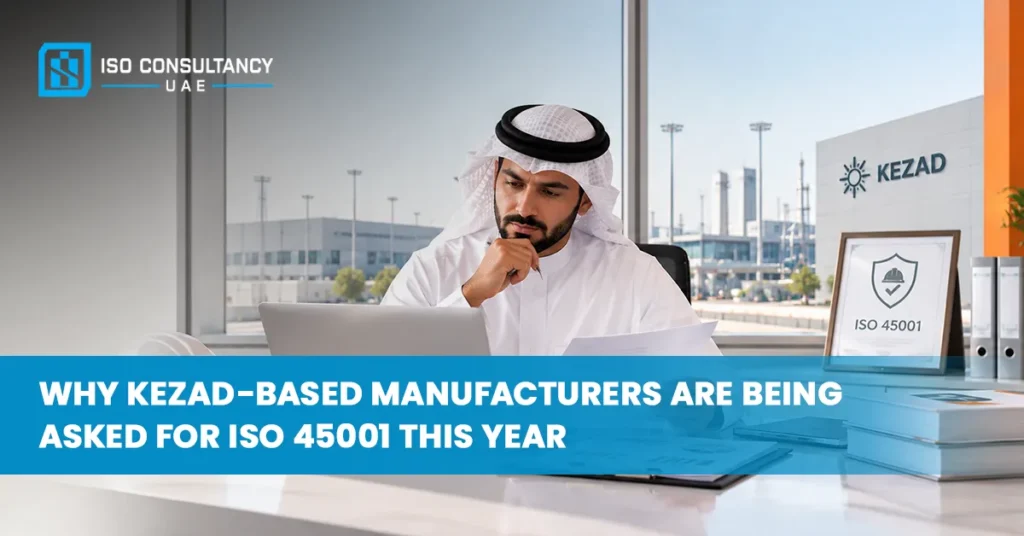
Manufacturers operating in KEZAD are seeing more questions about workplace safety systems, supplier approval, and recognised certifications. The phrase KEZAD manufacturers iso 45001 is becoming more relevant as industrial buyers, contractors, and business partners review how factories manage health and safety risks. This does not mean every manufacturer in the zone has automatically become legally required to hold ISO 45001 certification. In many cases, the request can come from a customer, tender, supplier assessment, or company policy. Understanding the reason behind the request can help a manufacturer respond correctly instead of treating every ISO request as a new legal obligation. The right approach starts by checking the source of the requirement, the activities covered, and the evidence already available within the company.
ISO Consultants UAE can help manufacturers review their current health and safety practices against ISO 45001 requirements and identify areas that may need attention. A factory may already have risk assessments, training records, emergency procedures, incident reports, and workplace inspections in place. These records can provide a useful starting point. The main question is how well the existing system matches the standard and what the requesting customer or organisation expects to see.
Why Are KEZAD Manufacturers Hearing More About ISO 45001?
Manufacturers in KEZAD are part of an industrial environment where customers and business partners may look closely at workplace safety controls before approving a supplier. A request for ISO 45001 can therefore appear during supplier registration, tender submissions, customer audits, or contract discussions. The increase in these requests does not by itself prove that a new blanket certification rule applies to every company. It may reflect stronger buyer expectations and a preference for recognised management systems.
ISO 45001 gives organisations a structured way to manage occupational health and safety risks. For a manufacturer, this can cover machinery, lifting activities, chemicals, maintenance, contractor work, emergency response, worker training, and incident management. A customer may see certification as evidence that these areas are managed through a documented system rather than handled only through individual procedures.
Is ISO 45001 Mandatory for Every KEZAD Manufacturer?
No. A manufacturer should not assume that operating in KEZAD automatically means it must hold an ISO 45001 certificate. KEZAD compliance requirements can include applicable health, safety, environmental, operational, and site-related obligations, while ISO 45001 is an international occupational health and safety management-system standard. The two should not be treated as the same requirement.
A manufacturer may still need ISO 45001 for commercial reasons. A customer can include it in a supplier questionnaire, a contractor can request it before awarding work, or a parent company can apply the same certification policy across its operations. A tender can also list ISO 45001 as part of its qualification criteria. The company should therefore check who has made the request and what exactly has been requested.
It is also useful to distinguish between having an ISO certificate and following good workplace safety practices. A company may have strong safety controls without certification, while another company may hold certification but still need to address specific site or regulatory requirements.
Who May Be Asking KEZAD Manufacturers for ISO 45001?
A manufacturer can receive an ISO 45001 request from different parties, depending on its customers, products, contracts, and supply chain position. The request may come through a formal qualification process or as part of a wider HSE review.
- Large industrial customers: Buyers may ask suppliers to provide recognised health and safety certification before approving them.
- Main contractors: Contractors may include ISO 45001 in prequalification requirements for manufacturers supplying projects.
- Procurement teams: A supplier questionnaire may ask for the company’s ISO certificates, audit records, or HSE documentation.
- International customers: Overseas buyers may prefer suppliers with certifications that are recognised across different markets.
- Parent or group companies: A group policy may require manufacturing sites to maintain the same occupational health and safety standard.
Manufacturers can also consult ISO Consultants in Abu Dhabi when a customer, contractor, or procurement team requests ISO 45001 certification and the company needs help understanding the certification requirements.
Why Does ISO 45001 Matter More for Industrial Manufacturers?
Manufacturing sites can involve several workplace hazards at the same time. ISO 45001 helps a company bring its safety responsibilities into one management system and review whether controls are working in daily operations.
- Machinery safety: Production equipment can create risks involving moving parts, maintenance, isolation, and machine operation.
- Lifting operations: Cranes, forklifts, hoists, and other lifting equipment need suitable controls and competent operators.
- Chemical exposure: Factories using chemicals need controls for storage, handling, exposure, spills, and emergency response.
- Contractor activities: External workers may perform maintenance, construction, electrical work, or other higher-risk activities inside the facility.
- Emergency situations: Fire, chemical spills, equipment failure, injuries, and other incidents require planned responses and trained personnel.
- Worker competence: Employees need suitable training and knowledge for the tasks, equipment, and risks associated with their work.
For companies considering a KEZAD free zone ISO certification, ISO 45001 Certification can provide a structured framework for managing occupational health and safety risks. The value is not limited to the certificate itself.
What Evidence May a KEZAD Manufacturer Need?
An ISO 45001 assessment looks beyond a written safety policy. The manufacturer needs records and practical evidence showing that its system is being applied and reviewed.
- OH&S policy: A documented policy should explain the company’s commitment to workplace health and safety.
- Risk assessments: Hazards should be identified for relevant activities, equipment, processes, and work areas.
- Training records: The company should retain evidence of worker training and competence.
- Incident records: Injuries, near misses, investigations, corrective actions, and follow-up should be documented.
- Emergency records: Emergency plans, drills, inspections, and related training should be maintained.
- Audit and review records: Internal audits and management reviews should show that the system is checked and improved when issues are found.
A company should also look at whether the documents reflect what actually happens inside the factory. Records that exist only for an audit may not provide a reliable picture of workplace safety.
Does Having ADOSH-SF Compliance Mean You Are Already Meeting ISO 45001?
Not automatically. Abu Dhabi’s occupational health and safety framework and ISO 45001 can cover similar subjects, but they are separate requirements and should be reviewed separately.
- Risk management: Both can involve identifying hazards and assessing workplace risks.
- Training: Worker competence and awareness can be relevant to both systems.
- Incident management: Investigation and corrective action can support both regulatory and management-system needs.
- Emergency planning: Emergency preparedness can form part of both sets of controls.
- Auditing: Organisations may need to review whether their procedures and controls are working.
- Management involvement: Senior management has responsibilities within a structured occupational health and safety system.
A company that already maintains a strong HSE system may have much of the evidence needed for ISO 45001. It should still carry out a gap review against the actual standard before claiming that the two systems are fully equivalent.
Which KEZAD Manufacturers Should Take an ISO Support Request Seriously?
A request deserves closer attention when it could affect an existing customer, upcoming tender, supplier registration, or planned expansion. This is especially relevant for manufacturers working with larger industrial buyers.
- A major customer has added ISO 45001 to its supplier requirements.
- A tender document lists ISO 45001 as a qualification condition.
- A contractor has requested an ISO certificate before approving the company.
- The manufacturer plans to supply international or highly regulated customers.
- The business operates machinery, chemicals, heavy equipment, or other higher-risk processes.
- A parent company has introduced a common occupational health and safety certification policy.
A KEZAD audit or customer assessment may also reveal gaps in records, procedures, training, or risk controls. Manufacturers should review the exact request rather than assuming that every audit has the same purpose.
How Can a KEZAD Manufacturer Prepare for an ISO 45001 Request?
Manufacturers can also work with ISO Consultants in Abu Dhabi to review their existing HSE system, identify gaps against ISO 45001, and prepare for the certification process.
1. Confirm the Request
Find out who is asking for ISO 45001 and whether certification is mandatory for the contract or simply preferred.
2. Define the Certification Scope
Identify the factory, activities, departments, products, and locations that need to be included.
3. Review Existing HSE Records
Check policies, risk assessments, training records, inspections, incident reports, emergency plans, and contractor controls.
4. Compare the Current System With ISO 45001
Identify missing requirements, weak records, unclear responsibilities, or controls that are not consistently applied.
5. Correct Operational Gaps
Address issues found during the review and give workers suitable training where needed.
6. Carry Out an Internal Audit
Review the system before the certification audit so the company has time to correct findings and prepare supporting evidence.
What Should a KEZAD Manufacturer Check Before Choosing ISO 45001 Certification?
Choosing a certification route requires more than comparing prices. The manufacturer should check what will actually be covered and how the certification process applies to its operations.
- Certification body: Check the certification body’s status and relevant accreditation.
- Certificate scope: Make sure the scope covers the actual manufacturing activities and site.
- Audit stages: Understand what happens during the certification assessment.
- Site coverage: Confirm whether all relevant KEZAD facilities need to be included.
- Surveillance audits: Ask how ongoing certification will be maintained after the initial assessment.
- Auditor experience: Check whether the audit team understands manufacturing risks and industrial operations.
A certificate should accurately represent the company’s activities. A narrow scope may not satisfy a customer if the customer expects certification for a wider part of the business.
What This Means for KEZAD Manufacturers in 2026
The growing attention around khalifa economic zone iso requirements should not be confused with a blanket statement that every manufacturer must now obtain ISO 45001 by law. The reason for a request matters. It may come from a customer, tender, contractor, procurement department, parent company, or another commercial party.
Manufacturers should also keep their local HSE responsibilities separate from voluntary or customer-driven certification. If a company receives an ISO 45001 request, the sensible starting point is to identify the requester, confirm the required scope, review the existing HSE system, and compare it with the standard.
For manufacturers that need help reviewing their current system, ISO Consultants UAE can provide guidance on the certification process, documentation, gap review, and audit preparation without treating ISO 45001 as a substitute for applicable UAE requirements.
Need Help With ISO 45001 in the UAE?
If a KEZAD manufacturer has received an ISO 45001 request and is unsure whether it comes from a customer, tender, or regulatory requirement, ISO Consultants UAE can review the situation and explain the practical steps involved. A clear review of the existing HSE system can help the company understand what is already in place and what may need attention before certification.
Conclusion
KEZAD manufacturers may be asked for ISO 45001 because customers, contractors, procurement teams, and other business partners want clear evidence of structured workplace safety management. This request should not automatically be treated as a new legal requirement for every manufacturer in KEZAD. Companies should check the source of the request, review their current HSE records, and understand the certification scope before taking action. A practical gap review can show what is already in place and what needs attention. ISO Consultants UAE can support manufacturers with system review, documentation, preparation, and certification guidance while keeping local UAE HSE requirements in view.
FAQs
Is ISO 45001 mandatory for all KEZAD manufacturers?
No. A company should check its specific legal, contractual, customer, and tender requirements before deciding if certification is needed.
Does KEZAD require every manufacturer to have ISO 45001?
Not every manufacturer should be assumed to have a blanket ISO 45001 certification requirement simply because it operates in KEZAD.
Can a manufacturer use its existing HSE system for ISO 45001?
Yes. Existing policies, risk assessments, training records, incident reports, and audits may support the certification process.
Is ISO 45001 the same as ADOSH-SF?
No. They can address similar health and safety areas, but ISO 45001 and the Abu Dhabi OSH framework are separate requirements.
Why would a customer ask for ISO 45001?
A customer may use the certificate as part of supplier qualification, HSE assessment, tender requirements, or its internal procurement policy.
How should a manufacturer respond to an ISO 45001 request?
The company should confirm the source and scope of the request, review its existing HSE system, identify gaps, and then decide on the appropriate certification route.