
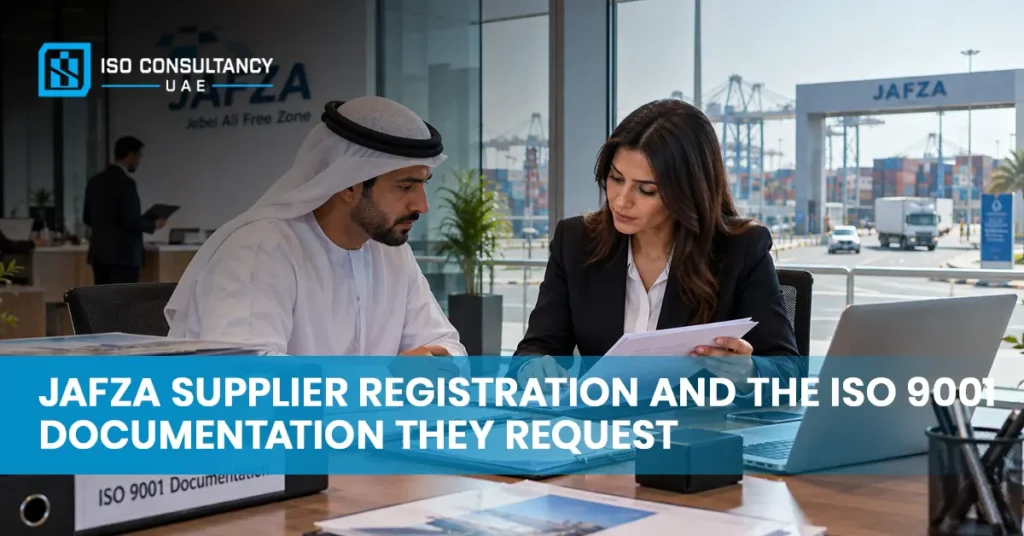
For businesses operating in the UAE, becoming an approved supplier can involve more than holding a valid trade licence. JAFZA supplier registration iso requirements may include company records, financial details, technical information, quality documents, insurance, and other records requested during supplier onboarding or prequalification. ISO 9001 can become relevant when a buyer wants evidence that a supplier follows a structured quality management system. The exact documents can depend on the buyer, industry, services, and contract requirements.
ISO Consultants UAE helps businesses prepare ISO 9001 documents for supplier and prequalification processes in Dubai. We review existing quality documents, identify missing records, and help organise QMS documentation around the company’s actual activities. This support can make it easier to respond when a customer or procurement team asks for ISO-related evidence. It can also help businesses keep their quality records ready for future customer reviews, tenders, and supplier assessments.
What Is JAFZA Supplier Registration?
JAFZA supplier registration is the process through which a business provides its company, commercial, technical, financial, and quality information to a buyer or procurement organisation for supplier onboarding or prequalification. It is different from setting up a company in JAFZA. A business can already hold a valid JAFZA licence and still need to complete a separate supplier registration process for a customer or procurement platform.
The purpose of supplier registration is to help buyers assess whether a company is legally established, financially suitable, technically capable, and able to meet the required quality and operational standards. JAFZA vendor registration requirements can vary between buyers and business activities. Some buyers may ask for a basic company profile and legal records, while others may request ISO certificates, project references, insurance, HSE records, financial information, and other supporting documents before approving a supplier.
Who May Need JAFZA Supplier Registration?
Companies supplying goods or services to businesses in JAFZA may need to complete supplier onboarding or prequalification. The exact requirements depend on the buyer, type of work, and contract.
- Industrial suppliers: Companies providing machinery, equipment, spare parts, materials, or industrial products may be asked to provide technical and quality records.
- Engineering and technical service providers: Contractors, maintenance companies, inspection firms, and engineering businesses may face additional quality, safety, and experience checks.
- Logistics and support companies: Businesses providing transport, warehousing, facility support, or related services may need commercial, insurance, and operational documents.
- Construction-related suppliers: Contractors and subcontractors can be asked for project references, HSE records, insurance, quality certificates, and technical information.
- Professional service providers: Consultants and other business service companies may need to submit company profiles, licences, references, financial details, and relevant certifications.
What Documents Are Commonly Required for Supplier Registration?
A supplier document pack normally combines legal, commercial, technical, financial, quality, HSE, and insurance information. The buyer’s current checklist should always be checked before submission because JAFZA compliance requirements can differ according to the supplier’s activities and the organisation purchasing the goods or services.
- Company and legal documents: These can include a valid trade licence, incorporation documents, ownership information, authorised signatory details, and other corporate records requested by the buyer.
- VAT and financial documents: A VAT certificate, bank details, bank references, audited accounts, or other financial information may be requested depending on the supplier category.
- Company profile and technical information: Buyers may ask for a company profile, product or service list, organisation chart, equipment details, and information about key personnel.
- Project and customer references: Previous contracts, completed projects, customer references, and experience records can help demonstrate that the supplier has relevant capability.
- Quality, HSE, and insurance records: ISO certificates, quality policies, HSE documents, insurance certificates, and other supporting records may be requested for specific activities.
Does JAFZA Supplier Registration Require ISO 9001?
ISO 9001 should not be treated as a universal requirement for every supplier operating in JAFZA. A buyer may request ISO 9001 certification as part of its supplier qualification process, but the actual requirement can depend on the type of goods or services, industry, tender, contract, and procurement policy. Some buyers may only request an ISO certificate, while others may ask for supporting quality-management records or a supplier questionnaire. For businesses researching iso 9001 JAFZA requirements, the buyer’s own supplier checklist should take priority over a general document list.
If ISO 9001 is listed as a condition, the certificate should be valid, and its scope should relate to the activities being supplied. Companies should also keep relevant QMS records ready if the buyer asks for evidence of how quality controls are managed. ISO 9001 certification can support supplier qualification, but it does not by itself guarantee approval.
ISO 9001 Documentation May Be Requested
The JAFZA supplier registration iso requirements can include more than the certificate itself when a buyer wants evidence of the supplier’s quality management system. The following documents may be requested depending on the supplier’s activities and the buyer’s procurement process:
- ISO 9001 certificate: A valid certificate can show that the company’s quality management system has been assessed by a certification body.
- QMS scope: This describes the activities, products, or services covered by the quality management system and should match the company’s actual business activities.
- Quality policy: The policy explains the organisation’s approach to quality and its commitment to meeting customer and applicable requirements.
- Quality objectives: These provide measurable quality goals that can relate to customer satisfaction, delivery performance, defects, complaints, or process performance.
- Relevant QMS records: Internal audit records, corrective-action records, supplier evaluations, training records, inspection results, customer feedback, and management review records may be requested where relevant.
ISO 9001 does not require every business to maintain one identical set of documents. The documented information needed can vary according to the organisation, its activities, processes, size, and operational needs. Suppliers should therefore prepare records that reflect their actual quality system instead of creating a generic file only for registration.
ISO 9001 Certification Versus ISO 9001 Documentation
An ISO certificate and the documents supporting a quality management system are not the same thing. A supplier may have a valid certificate but still need to provide supporting information during a buyer’s review.
| ISO 9001 certification | ISO 9001 documentation |
| Issued by a certification body | Created and maintained by the organisation |
| Shows that the QMS has been assessed against ISO 9001 | Shows how the QMS is managed and operated |
| Includes certification details and the certified scope | Can include policies, objectives, processes, and records |
| May be requested during supplier onboarding | May be requested during detailed prequalification or audits |
| Needs to remain valid for the stated activities | Needs to remain current and relevant to actual operations |
A certificate gives external evidence of certification, while QMS documents show how the business manages quality in practice. The buyer may request one or both depending on its supplier review process.
How to Prepare ISO 9001 Documentation for JAFZA
Good preparation starts by comparing the buyer’s document request against the company’s existing QMS. The following steps can help organise the required information. A clear JAFZA supplier registration iso file can also make it easier to respond to additional document requests during supplier review.
Step 1: Check the buyer’s supplier requirements
Read the supplier registration form, prequalification questionnaire, tender conditions, and document list carefully. Separate mandatory documents from records that are requested only where applicable.
Step 2: Review the ISO 9001 certificate
Check the company name, certificate number, certification body, issue date, expiry date, and scope. Make sure the scope relates to the goods or services your company plans to supply.
Step 3: Review the QMS scope and quality policy
Confirm that the QMS reflects the company’s current activities. If the company has changed its services, locations, processes, or structure, review the relevant documents before submission.
Step 4: Collect supporting quality records
Prepare relevant internal audit reports, corrective-action records, customer feedback, supplier evaluation records, training evidence, inspection records, and management review information.
Step 5: Organise the supplier document file
Keep corporate, financial, technical, quality, HSE, and insurance records in clearly named folders. Use current versions and remove outdated documents that could create confusion.
Step 6: Complete a final document review
Check expiry dates, company names, addresses, certificate scope, signatures, document versions, and requested attachments. A final review can identify missing or inconsistent information before the supplier pack is submitted.
Common Reasons Supplier Documentation Gets Delayed
Supplier onboarding can take longer when documents are incomplete, outdated, or inconsistent. Common issues include:
- Expired certificates: An expired ISO certificate, insurance document, trade licence, or other time-sensitive record can lead to additional requests.
- Incorrect ISO scope: The certificate may not cover the products or services the supplier wants to provide.
- Different company information: Differences in the company name, address, ownership details, or licence information can require clarification.
- Missing QMS evidence: A buyer may ask for supporting quality records when only the ISO certificate was submitted.
- Incomplete company profile: Missing information about services, experience, equipment, or key personnel can slow the review.
- Unclear document organisation: Poor file naming, duplicate documents, or missing attachments can make it harder for the procurement team to review.
JAFZA Supplier Registration Document Checklist
A supplier can use the following list as a starting point, then compare it against the exact buyer request. The JAFZA documentation required for one supplier may not be identical to another because activities and procurement requirements can differ.
- Corporate records: Valid trade licence, incorporation documents, MOA/AOA where applicable, ownership information, UBO details where requested, and authorised signatory information.
- Tax and financial records: VAT certificate, bank details, bank reference, audited financial statements, or other financial information where requested.
- Business and technical records: Company profile, product or service list, organisation chart, equipment information, technical catalogues, and key personnel details.
- Experience records: Previous project information, customer references, completed work, and relevant experience records.
- Quality and HSE records: ISO 9001 certificate where requested, QMS information, quality policy, HSE policy, safety records, and other relevant quality evidence.
- Insurance and other compliance records: Applicable insurance certificates, declarations, policies, and buyer-specific compliance documents.
When Should a Supplier Consider ISO Certification?
A supplier may consider ISO certification when customers, tenders, or procurement teams repeatedly ask for evidence of a formal quality management system. Certification can also be useful for companies seeking larger contracts or working with buyers that place strong emphasis on consistent processes and documented quality controls. It does not automatically result in supplier approval, and it should not replace the buyer’s full qualification process.
A company should first identify the customers and markets it wants to serve and review the certifications commonly requested in those contracts. The QMS can then be built around the company’s actual activities, customer needs, processes, and quality risks. This makes the certification more useful beyond a single supplier application and gives the business a maintained set of quality records for future customer assessments.
ISO Certification Can Support Supplier Qualification
ISO certification can provide useful evidence when a buyer evaluates a supplier’s quality-management practices. It can also help a company maintain clearer processes and records across its daily operations.
- Shows a structured quality system: Certification provides external evidence that the QMS has been assessed against ISO 9001 requirements.
- Supports buyer confidence: A valid certificate can give procurement teams documented evidence of a supplier’s quality-management framework.
- Helps prepare for prequalification: A maintained QMS can make it easier to provide quality information when supplier questionnaires request supporting evidence.
- Supports consistent processes: Documented procedures and records can help employees follow defined methods for important business activities.
- Provides useful quality records: Internal audits, corrective actions, customer feedback, and performance monitoring can provide evidence during customer reviews.
Conclusion
JAFZA supplier registration can involve more than submitting a trade licence and company profile. Buyers may review legal, financial, technical, quality, HSE, insurance, and operational information before approving a supplier. ISO 9001 may form part of that review when the buyer or contract requires evidence of a quality management system. The exact documents should always be based on the supplier’s activities and the buyer’s current requirements.
ISO Consultants UAE helps companies review ISO 9001 certificates, QMS documents, quality records, and supplier documentation before submission. We can help identify missing or outdated information and organise a clearer document set for customer or procurement reviews. A properly maintained QMS can also support future supplier applications, tenders, and customer assessments.
FAQs
Is ISO 9001 mandatory for every JAFZA supplier?
No. ISO 9001 requirements can depend on the buyer, industry, contract, tender, and supplier category.
What ISO 9001 documents may a supplier need to provide?
A buyer may request the ISO certificate, QMS scope, quality policy, objectives, and relevant quality records.
Is an ISO 9001 certificate enough for supplier prequalification?
Not always. A buyer may also request company, financial, technical, HSE, insurance, and supporting QMS documents.
Can a JAFZA company apply for supplier registration without ISO 9001?
Yes, where the specific buyer does not make ISO 9001 certification a condition of supplier qualification.
How can a supplier check its ISO documents before submission?
Review the certificate validity, company details, scope, document versions, and supporting QMS records against the buyer’s current checklist.