
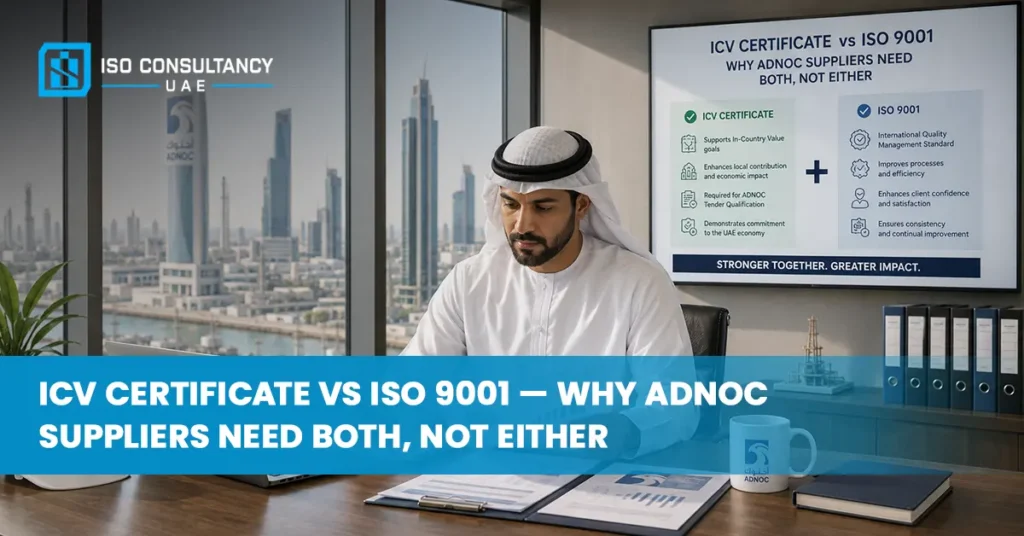
Many companies working with ADNOC face the same confusion. They assume that once they hold a quality certificate, they have automatically met every other requirement, including ICV. This is not correct. The ICV certificate iso 9001 relationship often gets mixed up, but these are two separate systems that measure two very different things. One looks at how well a company manages quality, while the other measures how much a company contributes to the UAE economy.
For any business trying to grow within the ADNOC supply chain, understanding this difference early can save time, money, and missed tender opportunities. Suppliers who confuse the two often lose valuable time reworking submissions close to a deadline, which is a mistake that can easily be avoided with proper planning. ISO Consultants UAE regularly works with suppliers who need clarity on exactly where these two certifications fit, and this guide breaks down the difference in simple, practical terms.
What Does ISO Certification Mean?
ISO certification is a way of showing that a company follows a recognised international standard for running its business. It is not a product certificate. It is a certificate for the way a company works internally, covering things like planning, documentation, staff responsibilities and continuous improvement. ISO 9001 is the most common standard, and it focuses on quality management. It shows that a company has proper systems in place to deliver consistent products or services, handle customer complaints, and keep improving over time. For ADNOC suppliers, ISO 9001 is often useful because it builds confidence that the company can deliver work reliably.
Many companies pursue ADNOC supplier certification alongside ISO 9001 because both help build a stronger, more credible profile with buyers. However, ISO certification says nothing about how much of a supplier’s spending, staffing, or operations happen inside the UAE. That is where ICV certification comes in, and it is a completely separate assessment.
What Does ICV Certification Mean?
ICV certification stands for In-Country Value certification. It was created as part of the UAE National ICV Program to encourage companies to invest more in the local economy. Rather than measuring how a company manages quality, ICV certification measures things like UAE national employment, local spending, local manufacturing, and reinvestment of profits within the country. A certified auditor reviews the company’s financial statements and business activities to calculate an ICV score. This score is then used by entities like ADNOC during procurement and tender evaluation, often giving preference to suppliers with stronger scores.
The ICV program in the UAE was designed specifically to strengthen the national economy, not to check how a company manages its internal processes. Because the ICV program in the UAE looks at economic contribution rather than internal management practices, suppliers cannot rely on an ICV certificate iso 9001 shortcut and must treat the two as separate goals. This is why ICV and ISO certification exist for entirely different reasons.
Why ISO Certification Does Not Replace ICV Certification
Having ISO certification does not mean that a supplier also has ICV certification. These two certificates are built around completely different goals, and one cannot stand in for the other.
- ISO certification focuses on quality management, covering how well a company plans, documents, and controls its internal processes to deliver consistent results to customers.
- ICV certification focuses on in-country value, measuring how much a supplier contributes to UAE employment, local spending, and economic development rather than internal quality systems.
- An ISO certificate does not provide an ICV score, since ISO auditors assess management systems and do not review financial records or workforce nationality data.
- ICV certification requires separate financial and business information, including audited financial statements, payroll details, and procurement records that ISO audits do not cover.
- ISO and ICV serve different purposes for ADNOC suppliers, with one supporting operational credibility and the other supporting national economic contribution and tender scoring.
How ISO Certification Affects ADNOC Suppliers
ISO certification can demonstrate a supplier’s quality-management capability, while the specific requirements set by ADNOC often depend on the supplier category and the tender being applied for. ISO Consultants UAE advises suppliers to review each tender carefully rather than assuming ISO 9001 alone will cover every listed requirement.
- It demonstrates structured quality-management processes, giving buyers confidence that the supplier follows a consistent and organised way of working across projects.
- It supports consistent products and services, since a certified quality system helps reduce errors, delays and inconsistent outcomes over repeated contracts.
- It may be relevant during supplier qualification, as some ADNOC group companies request evidence of an active quality-management system before approving vendors.
- It can support quality-related tender requirements, particularly for technical, engineering or manufacturing contracts where consistent output matters.
- It does not replace an ICV certificate or ICV score, meaning ISO certification alone cannot fulfil an ICV-related tender condition.
What Documents Should Suppliers Prepare for ISO Certification?
Suppliers should keep their quality-management records properly prepared and updated well before the certification assessment takes place.
- Quality policy and objectives, showing the company’s commitment to quality and the measurable goals it is working toward.
- Process documentation and procedures, covering how each key business activity is carried out from start to finish.
- Internal audit records, demonstrating that the company regularly checks its own processes for gaps or non-conformities.
- Corrective action records, showing how past problems were identified, addressed and prevented from happening again.
- Management review and performance records, proving that leadership actively monitors the quality system and makes improvements when needed.
Common Mistakes ADNOC Suppliers Make With ISO and ICV
Many suppliers run into avoidable problems simply because they misunderstand how these two certifications relate to one another. These mistakes are common, but they are also easy to avoid once the difference between ISO and ICV is properly understood.
Assuming ISO Certification Covers ICV Requirements
Some suppliers believe that once they are ISO certified, they have automatically satisfied ICV conditions as well. This assumption often leads to disqualification from tenders that specifically require an ICV certificate.
Treating ICV and ISO as the Same Certification
Because both involve audits and certificates, suppliers sometimes treat ICV and ISO 9001 ADNOC requirements as one combined process. In reality, they are handled by different bodies and assessed using completely different criteria.
Ignoring Tender-Specific Requirements
Not every ADNOC tender asks for both certificates. Suppliers who do not carefully read tender documents may prepare the wrong certification or miss a requirement entirely.
Preparing ICV Information at the Last Minute
ICV certification requirements involve detailed financial and workforce data. Companies that leave this preparation until close to a submission deadline often struggle to gather accurate records in time.
Keeping Quality and Financial Records Poorly Organised
Weak documentation slows down both ISO and ICV assessments. Suppliers with organised, up-to-date records generally move through both processes much faster.
Should You Get ISO Certification or ICV Certification First?
The order depends on the supplier’s current position, business category, and the applicable ADNOC requirements for their sector. There is no single correct sequence for every business, so it helps to look at your current documentation, financial readiness and upcoming tender deadlines before deciding where to start.
- Prioritise ISO certification if it is required for your applicable tender or category, especially for technical or manufacturing-related contracts.
- Start ICV preparation if your financial information is ready, since audited statements and payroll records take time to organise properly.
- If you already have ISO but no ICV, begin ICV preparation as soon as possible to avoid missing ADNOC supplier certification opportunities.
- If you already have ICV but face a relevant quality requirement, review the ISO 9001 ADNOC expectations for your specific tender category.
- Assess both separately when preparing for long-term ADNOC supplier opportunities, since future tenders may ask for either certificate depending on scope, and planning for the ICV certificate iso 9001 requirement together often saves time later.
Conclusion
ISO certification and ICV certification serve different purposes, and neither replaces the other. ISO 9001 shows that a company has a structured approach to managing quality, while ICV certification measures its contribution to the UAE economy. For ADNOC suppliers, understanding this difference helps avoid confusion when preparing for tenders and supplier requirements. The ICV certificate and ISO 9001 should be assessed separately, based on the applicable tender and supplier category.
Keeping quality, financial, and business records organised can also make preparation easier and reduce last-minute issues. ISO Consultants UAE helps suppliers understand both certification processes, prepare the required documentation, and address applicable requirements correctly. With proper preparation, businesses can approach their certification needs with greater clarity and confidence.
FAQs
Does ISO Certification Replace ICV Certification for ADNOC Suppliers?
No. ISO certification only confirms that a company has a working quality-management system. It does not calculate or replace an ICV score, so suppliers still need ICV certification separately when it is required.
Is ICV Certification Mandatory for Every ADNOC Supplier?
Not always. ICV certificate requirements depend on the tender, contract value and supplier category. Some tenders require it, while others may not, so it is important to check each specific requirement.
Does ISO 9001 Improve an ICV Score?
No. ISO 9001 measures quality-management practices, not financial or workforce data. It does not directly influence or improve an ICV score, since the two are calculated using entirely different criteria.
What Documents Are Needed for ISO Certification?
Common documents include a quality policy, process documentation, internal audit records, corrective action records, and management review records. These show that a structured quality system is actively being followed.
Should a New ADNOC Supplier Get ISO or ICV Certification First?
It depends on the tender and category involved. If ICV certificate requirements apply to your sector, financial preparation should start early. If ISO certification is required first, quality documentation should be prioritised accordingly.