
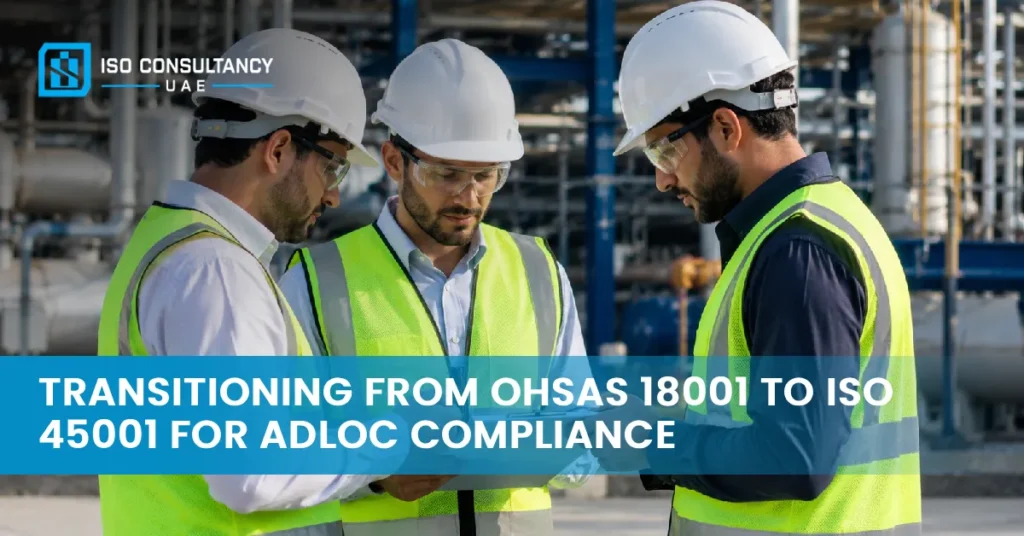
Businesses operating in Abu Dhabi are expected to demonstrate that workplace health and safety is controlled through a current, practical and auditable management system. For contractors, construction companies, oil and gas suppliers, manufacturers and industrial organizations, old OHSAS 18001 documents may no longer provide sufficient evidence during an ADLOC compliance review.
Transitioning from OHSAS 18001 to ISO 45001 is not simply a matter of replacing the standard name in existing procedures. ISO 45001 introduces stronger requirements for leadership, worker participation, risk-based planning, contractor control and continual improvement.
Companies preparing for ADLOC approval should therefore treat the transition as an operational project. The objective is to build an Occupational Health and Safety Management System that works across offices, workshops, projects, warehouses and client-controlled sites.
What Is OHSAS 18001?
OHSAS 18001 was an occupational health and safety specification used by businesses to manage workplace hazards, incidents, emergency arrangements and operational controls.
It helped many UAE companies formalize their HSE procedures and demonstrate a structured safety approach to clients. However, it was not an international ISO standard and did not integrate leadership, business context and worker participation as strongly as ISO 45001.
OHSAS 18001 has now been replaced by ISO 45001. Businesses should not present an expired OHSAS certificate as evidence of current certification during tenders, vendor registration or contractor approval.
What Is ISO 45001?
ISO 45001 is the international standard for Occupational Health and Safety Management Systems. It helps organizations identify workplace hazards, reduce safety risks, fulfil applicable requirements and improve OH&S performance.
The current published standard remains ISO 45001:2018, together with its 2024 climate-action amendment. A revised edition is under development, but organizations should continue using the published version until a new standard and formal transition requirements are issued.
Businesses requiring broader implementation support can review the company’s ISO 45001 certification in UAE service.
Why Was OHSAS 18001 Replaced?
OHSAS 18001 focused heavily on controlling workplace hazards. ISO 45001 expands that approach by connecting health and safety with leadership decisions, business planning, procurement, outsourcing and workforce consultation.
Under ISO 45001, senior management cannot transfer all safety responsibility to the HSE department. Operational managers, supervisors, procurement teams, human resources and employees must understand their roles.
The standard also requires organizations to consider how business changes affect safety. Workforce expansion, new equipment, new projects, subcontracting and urgent mobilization can create management-system risks even before physical work begins.
OHSAS 18001 and ISO 45001: Key Differences
| Compliance Area | OHSAS 18001 | ISO 45001 |
| Leadership | Often managed mainly by HSE personnel | Top management remains accountable |
| Business context | Limited formal requirement | Internal and external issues must be evaluated |
| Worker involvement | Consultation required | Stronger consultation and participation |
| Risk management | Mainly workplace hazards | OH&S risks, system risks and opportunities |
| Contractors | Controlled through operational procedures | Integrated with procurement and outsourcing |
| Improvement | Corrective and preventive action | Continual improvement and effectiveness review |
| Integration | Separate management structure | Easier integration with other ISO standards |
The transition should therefore improve how safety decisions are made. Merely changing document headings will not satisfy the intent of ISO 45001.
Why ISO 45001 Matters for ADLOC Compliance
ADLOC compliance may involve more than submitting an ISO certificate. Evaluators can examine whether the organization has established a working safety system appropriate to its activities and risk profile.
They may review the certification scope, HSE policy, risk assessments, legal register, competency records, incident investigations, emergency arrangements and contractor controls. They may also verify whether the system operates consistently across different sites.
A certificate issued to the wrong legal entity or with an unsuitable scope can create approval problems. For example, a general trading certificate may not support an application involving construction, lifting operations or industrial maintenance.
Organizations operating in Abu Dhabi should also understand the relationship between ISO 45001 and the Abu Dhabi Occupational Safety and Health System Framework. ADOSH-SF contains occupational safety requirements for applicable Abu Dhabi entities, while ISO 45001 provides an international management-system framework. The two systems share principles, but one should not automatically be treated as a replacement for the other.
The related ISO 45001 and OSHAD Abu Dhabi construction guide provides further local compliance context.
Who Should Complete the ISO 45001 Transition?
The transition is especially important for organizations applying for Abu Dhabi contractor approval, responding to safety-sensitive tenders or entering regulated supply chains.
Construction contractors need the system to manage changing site conditions, subcontractors, work at height, excavation and lifting operations. Oil and gas suppliers require stronger permit controls, competency checks and emergency coordination.
Manufacturers and industrial facilities use ISO 45001 to control machinery, maintenance, energy isolation, chemicals and occupational exposure. Logistics businesses can apply it to fleet safety, loading operations, fatigue, warehouse traffic and outsourced transport.
Companies uncertain about local requirements can obtain guidance from experienced ISO consultants in Abu Dhabi.
ISO 45001 Requirements Relevant to ADLOC
Leadership and Accountability
Top management must establish the safety policy, provide resources, approve objectives and review HSE performance. Leadership involvement should be visible through decisions and workplace actions rather than signatures alone.
An auditor may ask managers how safety risks influence project planning, procurement or resource allocation. If every question is redirected to the HSE Manager, leadership implementation may be considered weak.
Worker Consultation and Participation
Employees should be involved in hazard identification, risk assessment, incident investigation and operational changes.
Toolbox talks can support participation, but they should not be the only method. Workers should have accessible channels for reporting hazards, raising concerns and recommending improvements without fear of retaliation.
Risk-Based Thinking
ISO 45001 requires organizations to evaluate workplace hazards as well as risks that may affect the management system.
For example, employing inexperienced workers can create a competency risk. Starting several projects simultaneously can create shortages in supervision. Using subcontractors can introduce inconsistent working methods.
These risks should be assessed before they result in incidents or compliance failures.
UAE Legal Compliance
The legal register should explain which requirements apply, how they are implemented, who is responsible and what evidence demonstrates compliance.
A copied list of laws is not enough. The organization should evaluate whether legal and contractual requirements are being followed in practice.
Applicable requirements may include federal labour obligations, ADOSH-SF requirements, sector rules, civil defence conditions and project-specific HSE requirements.
Hazard Identification and Operational Controls
Risk assessments should cover routine, non-routine and emergency activities. They should reflect the actual workplace, equipment, worker groups and operating conditions.
Generic assessments for “construction work” or “maintenance work” are unlikely to provide sufficient control. Lifting, excavation, hot work, machinery maintenance and confined-space entry require task-specific assessment.
Controls should follow the hierarchy of elimination, substitution, engineering controls, administrative controls and personal protective equipment.
Contractor Management
Contractor compliance is particularly important where subcontractors perform high-risk activities.
The organization should verify contractor competence before appointment, communicate contractual HSE requirements and monitor performance during the work. Contractor assessment should continue after mobilization rather than ending with document collection.
Emergency Preparedness
Emergency plans should reflect credible operational scenarios. Depending on the business, these may include fire, gas release, chemical spills, serious injury, heat illness, confined-space rescue or vehicle incidents.
Drills should test communication, response time, equipment and employee understanding. Any weakness identified during a drill should be recorded and corrected.
Step-by-Step OHSAS 18001 Migration
Step 1: Confirm the ADLOC Requirements
The organization should first collect the latest approval checklist, tender conditions, client HSE requirements and certification expectations.
This prevents the company from developing a general ISO system that does not address the intended approval.
Step 2: Conduct a Gap Analysis
The existing OHSAS system should be compared against ISO 45001 requirements.
The gap assessment must examine documents and actual workplace practices. Leadership, worker participation, context, risks, contractor controls and performance monitoring normally require the most attention.
Step 3: Develop a Transition Plan
Each identified gap should have a responsible owner, completion deadline and required evidence.
High-risk operational and legal gaps should be addressed before formatting manuals or redesigning templates.
Step 4: Update the Management System
Useful OHSAS procedures do not need to be discarded. They can be updated where they remain relevant.
The policy, scope, responsibility matrix, risk methodology, legal register, contractor process and monitoring arrangements should be aligned with ISO 45001.
Step 5: Train Employees and Management
Training should reflect each person’s responsibilities. Senior management needs leadership awareness, while supervisors require practical operational-control training.
Employees should understand their hazards, reporting routes, emergency actions and right to participate in safety decisions.
Step 6: Generate Implementation Evidence
The revised system should be used long enough to generate credible records. These may include inspections, consultation records, training evidence, contractor evaluations, emergency drills and performance reports.
Step 7: Complete the Internal Audit
The internal audit should cover the complete certification scope and test whether procedures are being followed at operational level.
Auditors should interview workers, visit work areas and sample real records rather than reviewing the manual only.
Step 8: Conduct Management Review
Top management should review audit findings, legal compliance, incidents, objectives, resources and readiness for certification.
The review should produce decisions and assigned actions rather than only recording performance statistics.
Step 9: Complete Certification
The external certification process normally includes a Stage 1 readiness audit followed by a Stage 2 implementation audit.
Any nonconformities must be corrected before the final certification decision. The full ISO certification process in the UAE explains the main certification stages.
Common Transition Mistakes
The most common mistake is treating the ISO 45001 transition as a document-renaming exercise. This leaves leadership, participation and operational weaknesses unresolved.
Another problem is conducting the internal audit before the revised system has been implemented. Without sufficient records, the audit cannot confirm whether controls are effective.
Companies also face difficulties when risk assessments are generic, subcontractors are excluded or certification scope is selected without considering ADLOC requirements.
Choosing a certification body only on price can create further risk. The company should confirm that the certification arrangement is properly accredited and accepted by the intended client.
Documents Needed for ADLOC and ISO 45001 Preparation
The final documentation set depends on company size and activities. A practical system normally includes the OH&S policy, scope, risk assessments, legal register, training records, contractor evaluations, emergency plans, inspection reports, incident investigations, audit findings and management-review records.
Every important procedure should have corresponding evidence. A written inspection procedure has limited value if no inspections have been completed or recorded.
How Long Does the Transition Take?
A smaller business with an established OHSAS system may complete the transition in approximately three to four months. A multi-site contractor or high-risk industrial organization may require four to six months or longer.
The timeline depends on current system maturity, employee numbers, site count, risk level and the number of corrective actions required.
Transitioning early allows the organization to correct weaknesses and generate implementation evidence before an ADLOC review. A rushed project often results in incomplete records and repeated audit findings.
Frequently Asked Questions
Is OHSAS 18001 still valid?
OHSAS 18001 has been replaced by ISO 45001. Old procedures may still contain useful controls, but they should be reviewed and incorporated into a current ISO 45001 system.
Does ISO 45001 guarantee ADLOC approval?
No. Certification supports an application, but approval may also depend on certification scope, legal compliance, technical capability, competency and client-specific requirements.
Is ISO 45001 mandatory for every Abu Dhabi company?
It is not automatically mandatory for every organization. However, it may be required through tenders, vendor registration, client contracts or sector-specific conditions.
Can existing OHSAS documents be reused?
Yes. Effective procedures can be retained, but they must be reviewed against ISO 45001 requirements and actual business operations.
Is an internal audit required before certification?
Yes. The organization should complete an internal audit and management review before the external certification audit.
Who should manage the transition?
The HSE Manager may coordinate the project, but leadership, operations, procurement, human resources, supervisors and workers should participate.
How much does ISO 45001 certification cost?
Cost depends on employee numbers, risk level, locations, consultancy support and certification-body audit duration. Consulting and independent certification should be quoted separately.
When should a company start the transition?
The company should begin before submitting its approval application or tender. Early preparation provides time for implementation, training and corrective action.
Prepare for ADLOC Compliance with a Working ISO 45001 System
Transitioning from OHSAS 18001 to ISO 45001 for ADLOC compliance should improve how an organization controls workplace risk, manages contractors and fulfils legal responsibilities.
The objective is not to produce the maximum number of documents. It is to establish a system in which management remains accountable, workers participate and operational controls can be demonstrated through reliable evidence.
ISO Consultancy UAE supports businesses with gap assessment, documentation, risk and legal compliance reviews, employee training, internal audits, corrective actions and complete certification preparation.
Contact ISO Consultancy UAE for professional ISO 45001 transition and ADLOC compliance support in Abu Dhabi.