
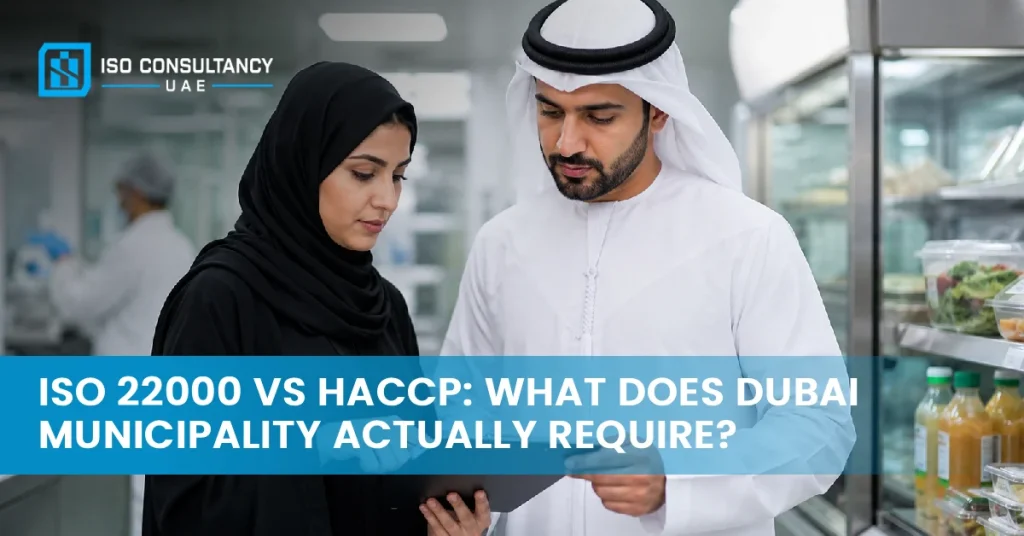
Dubai Municipality legally requires all food businesses in Dubai to implement a HACCP-based Food Safety Programme under the Dubai Food Code. ISO 22000 is not separately mandated, but it fully satisfies the HACCP requirement and goes further. The right choice depends on your business type, market, and commercial objectives.
- HACCP is the legal minimum for every Dubai food business under the Dubai Food Code
- ISO 22000 incorporates HACCP and satisfies Dubai Municipality + ADAFSA requirements
- ISO 22000 is NOT GFSI-recognised.d Carrefour/Lulu suppliers may need FSSC 22000
- HACCP: from AED 4,000 | ISO 22000: from AED 6,000–8,000 (small business)
Introduction
Frame the confusion: Dubai food business owners searching “ISO 22000 vs HACCP” are often trying to solve a compliance problem under time pressure, due to a licence renewal, a failed inspection, or a new buyer’s requirement. Many are told they need one and discover they actually need the other. The introduction establishes: Dubai Municipality has a clear legal answer; the commercial answer varies by business type; this article provides both. UAE context hook: over 17 million international visitors to Dubai in 202,4 and every hotel kitchen, cloud kitchen, airline caterer, and restaurant must navigate these exact requirements.
H2: What the Law Actually Says: Dubai Municipality’s Food Safety Requirements
Directly addresses the title’s core question; establishes legal authority before the comparison.
The Dubai Food Code and the HACCP Mandate
- Dubai Food Code legally defines “Food Safety Programme” as a system based on HACCP principles.
- Every food establishment in Dubai must document, submit,mit and maintain a HACCP plan as part of the food establishment permit application.
UAE Cabinet Decision No. 21 of 2020 The Federal Layer
- Federal law that sits above emirate-level municipal requirements and applies across all seven emirates
- Establishes national food safety obligations that HACCP and ISO 22000 both satisfy
- Key clarification: federal law sets the floor; emirate municipalities enforce and can impose additional requirements
What Happens If You Don’t Comply with FoodWatch and the Real Penalties
FoodWatch is the Dubai Municipality’s digital monitoring system. HACCP records, training certificates, and PIC credentials must be uploaded and current
ISO 22000 vs HACCP: The Structural Difference That Matters for UAE Businesses
What HACCP Is (and Is Not)
- A systematic methodology, seven principles from hazard analysis through record-keeping, not a management system standard
- HACCP certification = independently audited evidence that your hazard control system is operational, not just documented
- HACCP alone satisfies: Dubai Municipality inspections, ADAFSA requirements, FoodWatch compliance
- HACCP alone does NOT satisfy: international hotel brand supply chain requirements; airline catering supplier qualification; major UAE retail buyer onboarding; export market GFSI requirements
What ISO 22000:2018 Adds and Why It Matters
- ISO 22000 contains HACCP inside it (within Clause 8 Operational Controls); achieving ISO 22000 means you have satisfied HACCP requirements as a subset
- What ISO 22000 adds: management system framework (leadership commitment, internal communication, emergency preparedness, continual improvement, corrective actions), Prerequisite Programmes (PRPs), Operational Prerequisite Programmes (OPRPs)
- ISO 22000 satisfies Dubai Municipality, ADAFSA, UAE Cabinet Decision No. 21 of 202,0 and significantly more
The One Thing Most UAE Businesses Don’t Know: how ISO 22000 Is Not GFSI-Recognised
- ISO 22000 is an excellent, internationally recognised standard, but it is not benchmarked by the Global Food Safety Initiative (GFSI)
- Major global and UAE retailers (Carrefour, Lulu, and international chains) require GFSI-recognised certification from food suppliers, which means FSSC 22000 (built on ISO 22000), not ISO 22000 alone.
- UAE food businesses targeting major retail supply chains must plan for FSSC 22000, not ISO 22000, as the certification destination
A Decision Framework: Which Certification Does YOUR UAE Food Business Actually Need?
UAE-specific, business-type-mapped decision guides the content that most competitor pages fail to provide.
| Business Type | Minimum Regulatory Requirement | Commercially Recommended | When to Consider FSSC 22000 |
| Restaurant / Café (Dubai) | HACCP (Dubai Food Code) | HACCP | Not required |
| Cloud Kitchen (Dubai) | HACCP + PIC certification | HACCP | Not required |
| Hotel Kitchen (international brand) | HACCP | ISO 22000 | If the brand mandate specifies GFSI |
| Catering company (airline/hospital) | HACCP | ISO 22000 | If the airline specifies GFSI |
| Food Manufacturer (UAE domestic) | HACCP | ISO 22000 | If supplying Carrefour/Lulu |
| Food Manufacturer (export) | HACCP | ISO 22000 | Yes, most export markets |
| Food Distributor / Warehouse | HACCP | ISO 22000 | Buyer-dependent |
Emirates-by-Emirates: Is It the Same Across Dubai, Abu Dhabi, and Sharjah?
Gap-filling section competitors don’t provide addresses for multi-emirate businesses.
| Emirate | Enforcing Authority | Food Safety Requirement | Certification Body Requirement |
| Dubai | Dubai Municipality | HACCP-based Food Safety Programme (Dubai Food Code) | EIAC-accredited or IAF MLA member body |
| Abu Dhabi | ADAFSA | Equivalent HACCP-based requirements | EIAC or ENAS-accredited |
| Sharjah | Sharjah Municipality | HACCP-aligned requirements | Accredited body |
| Other Emirates | Respective municipal authorities | UAE Cabinet Decision No. 21 of 2020 baseline | Accredited body |
Estimated Costs, Timelines & What to Budget in AED
Concrete AED-denominated data a major gap in competitor content.
| Certification | Business Size | Estimated Audit Cost (AED) | Timeline | Certificate Validity |
| HACCP | Small (restaurant/café) | AED 4,000–8,000 | 4–8 weeks | 3 years + annual surveillance |
| HACCP | Medium (catering/manufacturer) | AED 8,000–15,000 | 6–12 weeks | 3 years + annual surveillance |
| ISO 22000 | Small | AED 6,000–10,000 | 4–8 weeks | 3 years + annual surveillance |
| ISO 22000 | Medium | AED 10,000–16,000 | 8–14 weeks | 3 years + annual surveillance |
| HACCP Plan Development only | All | AED 5,000–20,000 | 2–4 weeks | N/A (component, not certificate) |
| PIC Certification (per person) | All | AED 300–500 | 1–3 days | Renewal required |
| Occupational Health Card (OHC) | Per food handler | AED 300–600/year | Days | Annual |
Common Mistakes UAE Food Businesses Make with HACCP and ISO 22000
- Choosing a non-EIAC-accredited certification body certificate from bodies not recognised by EIAC or an IAF MLA signatory is not accepted by Dubai Municipality or ADAFSA, despite appearing legitimate
- Assuming ISO 22000 qualifies for GFSI retail supply chains, Carrefour, Lulu, and other UAE retailers with international parent companies require FSSC 22000, not ISO 22000; many UAE manufacturers discover this after certification
- Not uploading current certificates to FoodWatch, Dubai Municipality inspectors assess FoodWatch records digitally; a valid HACCP certificate not registered on FoodWatch does not protect against compliance action
- Conflating the HACCP with HACCP certification without developing a HACCP plan is a prerequisite for the food establishment permit (AED 5,000–20,000 alone), but it is not the same as third-party HACCP certification
- PIC training not completed before permit application.D ubai Municipality requires at least one Person In Charge to hold a valid, Dubai Municipality-approved PIC certificate; applying without it delays the entire permit process.
- Multi-emirate businesses using Dubai-only documentation fADAFSA.FSA ADAFSA (Abu Dhabi) has a separate registration and inspection system; a Dubai Municipality-compliant HACCP system satisfies Abu Dhabi requirements, but ADAFSA registration must be completed separately
Frequently Asked Questions
Is HACCP mandatory for all food businesses in Dubai?
Yes. The Dubai Food Code requires every food establishment in Dubai to implement a Food Safety Programme based on HACCP principles. This applies to restaurants, cafes, catering companies, hotel kitchens, food manufacturers, food packagers, and distributors. Operating without a current HACCP-based system exposes businesses to fines, closure, and licence revocation.
What is the difference between HACCP and ISO 22000 for UAE food companies?
HACCP is a methodology for identifying and controlling food hazards. It is the legal minimum for Dubai compliance. ISO 22000 is a full management system standard that contains HACCP within it and adds management commitment, communication systems, corrective actions, prerequisite programmes,s and continual improvement. Achieving ISO 22000 automatically satisfies HACCP requirements.
Does Dubai Municipality accept ISO 22000 instead of HACCP?
Yes. ISO 22000 incorporates HACCP principles and satisfies Dubai Municipality’s Food Safety Programme requirements. A business holding ISO 22000 certification from an EIAC-accredited body fully meets Dubai Food Code and FoodWatch requirements and is positioned for commercial opportunities beyond municipal compliance.
How much does HACCP certification cost in Dubai in AED?
HACCP certification for a small Dubai food business (restaurant, café, small catering operation) costs from AED 4,000–8,000, including both consultancy and certification body audit fees. Medium-sized food businesses typically invest AED 8,000–15,000. ISO 22000 starts from AED 6,000–10,000 for small businesses. All figures are for 2025–2026 and depend on business size, number of employees, and scope.
How long does it take to get ISO 22000 certification in the UAE?
For a small UAE food business with some existing food safety documentation, ISO 22000 certification typically takes 4–8 weeks from gap assessment to certificate issuance. Larger or more complex operations, or those starting from scratch, should plan for 8–14 weeks. Annual surveillance audits are required throughout the 3-year certificate cycle.
Does ADAFSA in Abu Dhabi have the same food safety requirements as Dubai Municipality?
ADAFSA (Abu Dhabi Agriculture and Food Safety Authority) enforces structurally equivalent food safety requirements across Abu Dhabi, Al Ain and the Western Region. Both require HACCP-based systems aligned with UAE Cabinet Decision No. 21 of 2020. However, ADAFSA is a separate authority with its own registration and inspection processes. Abu Dhabi businesses must register with ADAFSA directly, not rely on Dubai Municipality registration.
When should a UAE food business upgrade from HACCP to ISO 22000?
The trigger for upgrading is commercial, not regulatory. Dubai Municipality accepts HACCP. The upgrade to ISO 22000 makes business sense when: (1) supplying airlines, hospitals or schools that require a full management system standard; (2) applying for hotel brand supply chain approval; (3) targeting export markets; or (4) tendering for UAE government catering contracts. If none of these apply, HACCP certification is sufficient.
Conclusion
Dubai Municipality legally requires HACCP. ISO 22000 exceeds that requirement and is the smarter commercial choice for most food businesses beyond the entry level. The right decision depends on your business type, your buyers, and your markets. Frame the consultancy CTA: isoconsultancyuae.com helps UAE food businesses get the right certification for their specific situation.